Privacy Policy: Your email address is 100% safe.
We don't spam and hate it as much as you do :-) You can also unsubscribe from our mailing list at any time.

Subscribe to The FREE Schipperke Training Course to learn how you can easily turn your unruly and disobedient Spits into a loving, friendly companion. Step-by-step tips for puppy housebreaking, dog obedience training and stopping bad behavior.
Sign Up
Sign Up
Schipperke: Personality, Exercise, Grooming
About Schipperke
Country of Origin, History of Schipperkes
The Schipperke was bred in Flanders by a canal boat captain named Renssens. Thought to be descended from the same sheep-herding stock as the black Belgian Sheepdog, the Schipperke was bred smaller and smaller to became a different breed entirely. It became a favorite choice to guard canal barges in Belgium. The dogs were the "ratters", a very important function on a canal barge, and also usually the captain's dog –thus, the “Little Skipper” or “Little Captain” which is what ‘schipperke’ means.
Today the Schipperke is primarily a companion dog. The Schipperke does very well on boats, so people often get this breed to go with them on boating and fishing trips. The dog thoroughly enjoys his trip. When the boat anchors for the night, the dog alerts his people of anything out of the ordinary.
Schipperke Tools
Breed Selector Tool - is the Schipperke the right breed for you?
Is the Schipperke the right breed for you and your family?
Find out by using our Free Dog Breed Selector Tool
Check Your Schipperke's Learning Style
Are you aware dogs also have a learning style that can greatly affect their ability to housetrain as well as be trained correctly. Evaluate your Schipperke's learning style and personality using our free Learning Style tool so that you are better able to provide him with the proper Schipperke training methods.
Is your Schipperke dominating over you?
Does your Schipperke bark unnecessarily? Does your Schipperke come to you when you call? Download a FREE Report on Dog Dominance for you and your Schipperke and learn how to control your dog.
Do you make these mistakes with your Schipperke?
Are you inadvertently snow-balling bad behavior in your Schipperke? Evaluate your Dog Training Style from our Free Tool and learn how best to deal with your dog.
Schipperke Calorie Calculator
Do you know how many calories your Schipperke needs every day and how many cups of food you should be giving it every day? Click here to use our Schipperke Calorie Calculator.
A General Appearance of the Dog
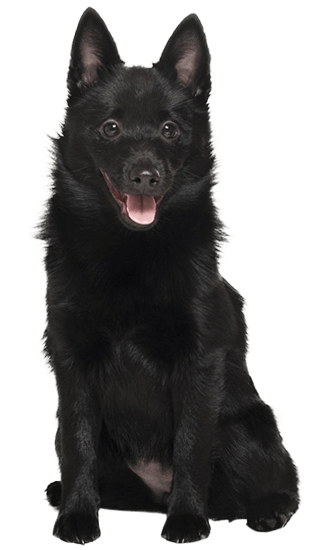
The small, tail-less Schipperke has a compact, blocky body covered with a very thick double coat which sports a heavy ruff around the neck. Only black is accepted in the United States and Belgium, but other colors are accepted elsewhere. The Schipperke’s face is wedge-shaped with a pointed nose like a fox. His small, oval eyes are dark with a mischievous expression. He appears to have a basically even slope from the top of his head to his rump.
Coat Color
Only black is accepted in the US and Belgium. Tans and fawns are accepted elsewhere.
Coat Type
The Schipperke’s coat is abundant, dense and harsh. His head, ears and legs are smooth. The coat is short and lies close on back and side. Then it stands out, erect and thick around the neck, forming a heavy mane and frill. It is longer on the back of the thighs, forming what is called culottes.
They shed their coat 3-4 times a year and are totally naked for several weeks.
Height: 10 – 13 inches
Weight: 12 – 18 lbs

Free Schipperke Training Secrets
Free Course on Schipperke Training & Obedience
Stop All Bad Behavior, Excessive Barking and Biting
Schipperke Personality Traits

Temperament of the Schipperke Dog
Determined and alert, the Schipperke will defend its territory, whether it is an apartment or a piece of land, against both two-legged and four-legged intruders. If someone new visits, they will adopt a watchful position. Pet cats will be happily accepted and Schipperkes are usually good with other dogs. They are very smart, curious and mischievous. The Schipperke can be willful; however, he is usually easy to train as he is intelligent and eager to learn.
The Schipperke is a quick, energetic little dog. He is hot-tempered, high-spirited, self-confident and protective. His wariness of strangers may seem somewhat aloof, but he is actually very devoted and loyal, especially with children. He bonds very closely to his master.
The Schipperke likes to howl and bark. These dogs do exceptionally well on boats. The Schipperke will defend its home against intruders - backing down from nobody. He is an excellent friend to children. Some can be difficult to housebreak.
Better suited to an indoor or outdoor lifestyle?
If temperatures are not too extreme, he can stay outdoors most of the time. However, he needs a place to get away from the elements like a dog house. His preference is to stay in the house.
Are they suited to homes with kids?
He is an excellent friend to children. They are fairly good family dogs.
Schipperke Activity Level
How Active is the Breed?
This is a very quick and energetic
dog. They are very active indoors and outdoors.
They particularly enjoy running free in a safely
fenced area or going on a run or jog.
The Schipperke can easily live in an apartment as
long as he gets exercise through play and gets to
go on a couple of nice, long walks a day.
How Much Exercise Does the Dog Need at every stage of its Life?
Schipperkes remain quite active throughout their lives. Always make sure they are in a very securely fenced area before letting them off lead as they are very fast.
Grooming
The double coat needs to be brushed at least weekly. Three to four times a year, the Schipperke will shed pretty much its entire coat so needs lots of extra brushing at those times. The entire coat is shed and the dog is basically naked for several weeks.
Free Schipperke Training Secrets
Free Course on Schipperke Training & Obedience
Stop All Bad Behavior, Excessive Barking and Biting
Health and Care
Genetic Problems
Schipperkes are prone to hypothyroid, epilepsy, hip dysplasia and hip sockets which tend to slip. Legg Calves Perthes, Progressive Retinal Atrophy (PRA), Cataracts, and a newly discovered disease called MPS 111B are also prevalent. There is a genetic test available for the MPS 111B through the Univ. of Pennsylvania.
Be careful not to overfeed this breed.
Life Span: 15 or more years
National Breed Clubs
National Breed Clubs
British – Schipperke Club
– www.schipperkeclub.co.uk
US – Schipperke Club of America, Inc. –
www.schipperkeclub-usa.org
Other Recognition: CKC, FCI, AKC, UKC, KCGB, CKC, ANKC, NKC, NZKC, SCiPS, APRI, ACR
Rescue Link: www.schipperkeclub-usa.org/RegionalRescueContacts.pdf
Group: Non-Sporting Group.
AKC Popularity Ranking: 105
Train Your Schipperke To Listen To You
Get Instant Access to Your Training Now - For Free
Sign up for our Free Schipperke Mini Course to have a housebroken, obedient dog that happily comes to you every time you call.
You'll learn new commands to obedience-train your dog as well as how to housebreak your dog in 6 days or less.
You'll also learn how to eliminate bad habits like barking, nipping or biting, jumping, or pulling on the leash.Here's just s small fraction of what else you'll learn in the course:
How to lead and think like a pack dog - the new psychology.
3 dangerous mistakes that most Spits owners make when they are trying to potty train their dogs.
The 2 main reasons why your dog barks excessively and how to control its excessive barking.
How to obedience train your Schipperke to permanently end behavioral problems like Jumping, Aggression, Pulling on Leash.
A surprisingly easy way to teach your dog cool new tricks.
How to improve your dog's lifespan and keep it from getting overly heavy with a healthy and nutritious diet.
Getting Pro help fast - how to get access to our expert trainers when you need them most.
One hidden psychological trigger that all Schipperkes have... that practically allows you to "analyze" and "control" your dog's every action.
Priority access to the free online seminars conducted by our training experts.
Whereas other dog training related web sites and books offer generic information for dogs in general, ours is the ONLY web site that offers Spits information specifically, from a renowned panel of experts - because as you probably know, Spitss have their own special training requirements that other dogs don't have.




What Other Dog Owners Say…

Our Free Courses
Dog Obedience TrainingDog Housetraining
Stop Dog Barking
Stop Dog Biting
HomeMade Dog food
Dog Grooming
Adopting A Dog
Read More
PureBred Dog BreedsMixed Dog Breeds
Dog Groups
Training Small Dog Breeds
Training Medium Dog Breeds
Training Large Dog Breeds
Exercising Your Dog
Dog Health
More Articles
Dog Grooming Needs
Our Tribute