Privacy Policy: Your email address is 100% safe.
We don't spam and hate it as much as you do :-) You can also unsubscribe from our mailing list at any time.

Subscribe to The FREE Landseer Training Course to learn how you can easily turn your unruly and disobedient Landseer into a loving, friendly companion. Step-by-step tips for puppy housebreaking, dog obedience training and stopping bad behavior.
Sign Up
Sign Up
Landseer: Personality, Health, Grooming
About Landseer
Country of Origin, History of Landseers
Sir Edwin Henry Landseer was a notable figure in 19th Century British art. Landseer came to be the official name for the breed of Newfoundland dogs that the painter popularized in his paintings. The origin of the Landseer stems back to Germany and Switzerland. In the USA and Great Britain, the Landseer is considered the same breed as the Newfoundland.
However, the Fédération Cynologique Internationale and people in some European countries consider the Landseer as a breed totally different from the Newfoundland. There is no appearance of cross-breeding in Landseer’s dog; on the contrary, he reveals all the characteristics of a thoroughbred.
Landseer Tools
Breed Selector Tool - is the Landseer the right breed for you?
Is the Landseer the right breed for you and your family?
Find out by using our Free Dog Breed Selector Tool
Check Your Landseer's Learning Style
Are you aware dogs also have a learning style that can greatly affect their ability to housetrain as well as be trained correctly. Evaluate your Landseer's learning style and personality using our free Learning Style tool so that you are better able to provide him with the proper Landseer training methods.
Is your Landseer dominating over you?
Does your Landseer bark unnecessarily? Does your Landseer come to you when you call? Download a FREE Report on Dog Dominance for you and your Landseer and learn how to control your dog.
Do you make these mistakes with your Landseer?
Are you inadvertently snow-balling bad behavior in your Landseer? Evaluate your Dog Training Style from our Free Tool and learn how best to deal with your dog.
Landseer Calorie Calculator
Do you know how many calories your Landseer needs every day and how many cups of food you should be giving it every day? Click here to use our Landseer Calorie Calculator.
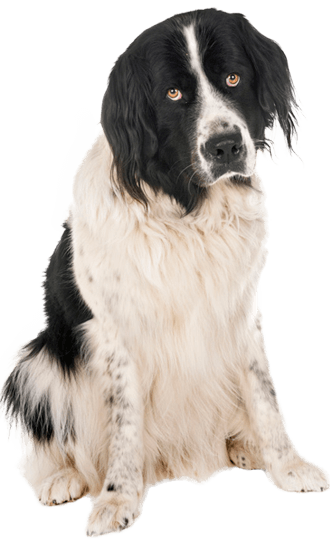
A General Description of the Breed
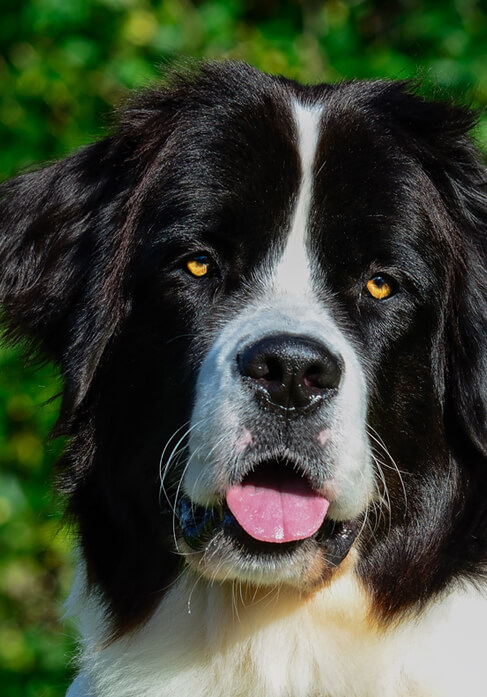
The Landseer conveys the impression of being a tall, powerful and well-balanced dog. The white, wide muzzle is rather short and squared-off. The small triangular ears are pendant. The small eyes are dark brown. The nose is black. The feet are webbed for better swimming. The tail hangs down. The water-repellent long outer coat is flat, oily and slightly wavy with a thick oily undercoat. Dogs that live indoors, however, tend to lose their undercoats.
Coat
The top coat, with exception of the head, is long, straight and dense, soft to the touch. When brushed in the wrong way, it falls back into place naturally. The main color of the coat is a clear white with distinct black patches on body and croup. Collar, chest, belly, legs and tail are white. The head is black, with a white symmetrical blaze. It has a slight roll in gait.
Height
Male: 28 ½ -31 ½ inches (72-80 cm.)
Female: 26 ½-28 ½ inches (67-72 cm.).
Weight
Male: 130-150 pounds (59-68 kg)
Female: 100-120 pounds (45-54kg).

Free Landseer Training Secrets
Free Course on Landseer Training & Obedience
Stop All Bad Behavior, Excessive Barking and Biting
Landseer Personality Traits
Temperament of the Breed
The Landseer possesses all the qualities required to make a treasured pet. It is of an extremely sweet disposition, courageous, intelligent, patient, noble, calm, gentle, trustworthy, dignified and peaceable. The Landseer is fiercely protective of and devoted to its master and mild with guests and other animals. Playful, sociable and loving, specially with children, it makes a “natural babysitter”. Makes decisions and acts quickly and with admirable accuracy, specially when the family is threatened. They may be slightly difficult to train as their huge bodies move rather slowly. They are very sensitive to the tone of their masters' voices.
Better suited to outdoor or indoor lifestyle?
The Landseer is well suited to apartment life. It craves for companionship and gets terribly upset if left alone. They are relatively inactive indoors and a small yard is sufficient for them. They are sensitive to heat. So it's vital to provide them with plenty of shade and cool water in warm weather. These dogs prefer cool climates.
Landseer Activity Level
How active is the breed?
This breed prefers lazing around the house and would be quite content to sleep away for hours at a stretch. However, it's very important to ensure that the dog gets its daily requirement of exercise so that it doesn't get overweight. A daily brisk walk should suffice. It also enjoys playing, swimming and frolicking with its owner.
Grooming
The coat of the Landseer is thick and coarse, so daily brushing with a hard brush is necessary. The undercoat is shed twice a year, in the spring and fall. Frequent bathing will strip away the natural oils in the coat, so only dry shampoo is recommended.
Free Landseer Training Secrets
Free Course on Landseer Training & Obedience
Stop All Bad Behavior, Excessive Barking and Biting
Health and Care
The Landseer is prone to hip dysplasia (a malformed ball and socket in the hip joint) and a hereditary heart disease called sub-aortic stenosis (SAS). Breeders should have the puppy's hearts checked by a veterinary cardiologist at 8-12 weeks of age.
National Breed Clubs
Life Expectancy: The Landseer is expected to live for around 10 years.
Group: mastiff Group
AKC Popularity Ranking: Not Recognized BY AKC
Train Your Landseer To Listen To You
Get Instant Access to Your Training Now - For Free
Sign up for our Free Landseer Mini Course to have a housebroken, obedient dog that happily comes to you every time you call.
You'll learn new commands to obedience-train your dog as well as how to housebreak your dog in 6 days or less.
You'll also learn how to eliminate bad habits like barking, nipping or biting, jumping, or pulling on the leash.Here's just s small fraction of what else you'll learn in the course:
How to lead and think like a pack dog - the new psychology.
3 dangerous mistakes that most Landseer owners make when they are trying to potty train their dogs.
The 2 main reasons why your dog barks excessively and how to control its excessive barking.
How to obedience train your Landseer to permanently end behavioral problems like Jumping, Aggression, Pulling on Leash.
A surprisingly easy way to teach your dog cool new tricks.
How to improve your dog's lifespan and keep it from getting overly heavy with a healthy and nutritious diet.
Getting Pro help fast - how to get access to our expert trainers when you need them most.
One hidden psychological trigger that all Landseers have... that practically allows you to "analyze" and "control" your dog's every action.
Priority access to the free online seminars conducted by our training experts.
Whereas other dog training related web sites and books offer generic information for dogs in general, ours is the ONLY web site that offers Landseer information specifically, from a renowned panel of experts - because as you probably know, Landseers have their own special training requirements that other dogs don't have.




What Other Dog Owners Say…

Our Free Courses
Dog Obedience TrainingDog Housetraining
Stop Dog Barking
Stop Dog Biting
HomeMade Dog food
Dog Grooming
Adopting A Dog
Read More
PureBred Dog BreedsMixed Dog Breeds
Dog Groups
Training Small Dog Breeds
Training Medium Dog Breeds
Training Large Dog Breeds
Exercising Your Dog
Dog Health
More Articles
Dog Grooming Needs
Our Tribute