Privacy Policy: Your email address is 100% safe.
We don't spam and hate it as much as you do 🙂 You can also unsubscribe from our mailing list at any time.
Subscribe to The FREE Dog Training Course to learn how you can easily turn your unruly and disobedient Dog into a loving, friendly companion. Step-by-step tips for puppy housebreaking, dog obedience training and stopping bad behavior.
Submissive / Excitement Urination in Dogs
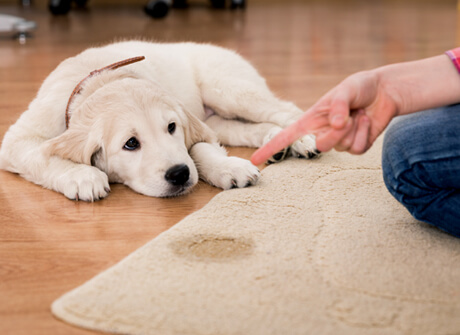
Many dogs have a tendency to urinate (pee) when excited or scared, which can happen to other breeds as well, particularly when they are puppies. Excitement urination happens when infant muscles in puppies cannot hold urine if the puppy gets excited, and it pees. The puppy gets so excited when he sees his owner that he loses control of his bladder. The puppy is not aware of or able to control this and punishment will confuse him and is not fair to him.
Often dogs outgrow this problem as they mature and gain control of the muscles that control peeing. Sometimes dogs do not outgrow the problem.
Common situations in which dogs get excited or fearful and urinate are:
Over-affectionate and boisterous greetings when you arrive home
Guests entering your home
Arguments between people
Scolding
Loud noises
Playing indoors
Angry behavior
In order to understand submissive urination, you must understand dominance and submissiveness. Young puppies learn this from their mothers. Averting their eyes, rolling on their backs, and urinating, are all used to express submissiveness. In situations where a dog feels intimidated, their response is to give a submissive signal to show the person or other dog that they recognize their dominance.
The most important thing is to never scold or punish your dog for excitement urination; it makes the situation worse as the puppy will then start to pee out of fear! Excitement or submissive urination is part of this breed’s specific instincts. It is not a “behavior”; it is instinctual. The dog is not doing it to be disobedient or punish you! He is excited, scared, or showing submissiveness to a person or animal he perceives as dominant. Excitement urination that causes an owner to get angry can easily become submissive urination. The dog does not understand why you are angry and, in a dog’s mind, peeing is his attempt to calm and appease you.
Some dogs like Cocker Spaniels, Daschunds and some others often see other animals and people as dominant, so submissive urination occurs. Even a housetrained dog may show excitement or submissive urination when greeting you or when in an exciting or scary situation.
How to Prevent and Stop Excitement or Submissive Peeing in Dogs?
The first thing to do is have your veterinarian examine your dog for possible physical problems causing this problem. Sickness and disease can make it difficult for your pet to control their peeing muscles. If physical problems are the cause, discuss options regarding your dog’s situation with your veterinarian, such as surgery, drugs, and coping mechanisms.
Dog owners who are too dominant and strict will reinforce submissive urinating. So, calm down and be gentle and kind with your dog. Get your temper under control! Never scold or punish for excitement or submissive urination.
One way to handle the problem is to make sure your dog is outdoors while you are gone (in a fenced and safe area naturally) so that when you come home, if he urinates, your floors are not damaged. But this does not solve the problem. It is a good idea to do more to help the puppy stay dry.
All indoor activities should take place only after taking the dog out for a pee or poop. If a dog is almost ready to pee or poop, but hasn’t gotten around to doing it, any physical activity will trigger the urge to go. So, if your dog wakes up and you start playing with her, you’re asking for trouble! Take a potty break first, have play time second. Play time outdoors is the best idea, especially for the puppies that have small bladders.
Don’t hover over your dog when you come home. She will see this as dominance and will become intimidated. Don’t look her directly in the eyes. Dogs assume that direct eye contact is a challenge. For a submissive dog, even a moment’s eye contact can be intolerable. Eye contact from above heightens the reaction.
Another behavior that challenges a dog is bending over or touching the dog’s head, neck, or shoulders. Dominant dogs often control by placing the neck or a paw over another dog’s neck or shoulders. When a human pats a dog on the head, a submissive dog sees it as a display of dominance and finds it intimidating, leading to peeing.
A goal in controlling excitement urination is to prevent your dog from becoming so excited in the first place. Do this by exposing your dog to whatever excites him, over and over until it no longer excites him. If your dog gets excited and wets when you return home, ignore him; don’t even look at him. Then take him outside to pee. Then leave again for a few minutes, return and ignore, leave, return and ignore.
Keep doing this until you can see that your dog is actually bored with the whole thing. If excitement urination is a problem when visitors arrive, have them do this too. It may take many sessions to get your dog calmed down. When your dog stays calm and no longer gets excited when you come in, then very quietly and gently say hello. If any signs of excitement appear, repeat the coming in-and-leaving routine. A rapid sequence of heel-sits will capture your dog’s attention to the game of heeling and sitting instead of urinating. Then, take him outdoors. Praise him when he pees outside; this builds self-confidence.
Remember to ignore all excitement urination and never scold or get angry at your dog. As the dog matures, he can learn to sit and shake hands when visitors arrive.
Use a small food treat as a reward for not peeing in the house when you arrive home or guests enter. It’s difficult for a dog to eat and pee at the same time. Take the dog outdoors quickly thereafter.
If your dog pees while being trained, be especially careful not to yell or scold him. Be firm and use a confident-sounding, but kind, “No” when the dog misbehaves.
If your dog’s problem doesn’t improve with the above suggestions, there may be other options. For example, drugs can sometimes be prescribed by a vet for excitable dogs to calm them down. But, remember, this kind of training can take weeks or months before it improves. Stick to one or two techniques. Give them time to work!
Obedience classes are excellent for your dog. It will teach you ways that you unconsciously reinforce negative behaviors and how to encourage and praise your dog.
Build a strong relationship with your dog using kindness, daily attention, and formal training. Never yell, hit, or scold your dog when she urinates inappropriately. Use the above tips from the time she is a puppy to help her avoid or eliminate excitement or submissive urination behaviors. Remember! Stay calm and give the dog time to learn.
Train Your Dog To Listen To You
Sign up for our Free Dog Mini Course to have a housebroken, obedient dog that happily comes to you every time you call.
You'll learn new commands to obedience-train your dog as well as how to housebreak your dog in 6 days or less.
You'll also learn how to eliminate bad habits like barking, nipping or biting, jumping, or pulling on the leash.