Privacy Policy: Your email address is 100% safe.
We don't spam and hate it as much as you do :-) You can also unsubscribe from our mailing list at any time.

Subscribe to The FREE Welsh Terrier Training Course to learn how you can easily turn your unruly and disobedient Welshie into a loving, friendly companion. Step-by-step tips for puppy housebreaking, dog obedience training and stopping bad behavior.
Sign Up
Sign Up
Welsh Terrier: Key Characteristics of Welsh Terrier Dog Breed
About Welsh Terrier
Country of Origin, History of Welsh Terriers
The Welsh Terrier was developed for use in the Wales to hunt otter, fox and badger. He also worked with hounds in packs. He may be an offshoot of the old British Black and Tan Terrier.
Most of today’s Welsh Terriers are companion dogs, but there are still working dogs. They are excellent at competitive obedience and agility as well as hunting, tracking, and watch dog duties.
Welsh Terrier Tools
Breed Selector Tool - is the Welsh Terrier the right breed for you?
Is the Welsh Terrier the right breed for you and your family?
Find out by using our Free Dog Breed Selector Tool
Check Your Welsh Terrier's Learning Style
Are you aware dogs also have a learning style that can greatly affect their ability to housetrain as well as be trained correctly. Evaluate your Welsh Terrier's learning style and personality using our free Learning Style tool so that you are better able to provide him with the proper Welsh Terrier training methods.
Is your Welsh Terrier dominating over you?
Does your Welsh Terrier bark unnecessarily? Does your Welsh Terrier come to you when you call? Download a FREE Report on Dog Dominance for you and your Welsh Terrier and learn how to control your dog.
Do you make these mistakes with your Welsh Terrier?
Are you inadvertently snow-balling bad behavior in your Welsh Terrier? Evaluate your Dog Training Style from our Free Tool and learn how best to deal with your dog.
Welsh Terrier Calorie Calculator
Do you know how many calories your Welsh Terrier needs every day and how many cups of food you should be giving it every day? Click here to use our Welsh Terrier Calorie Calculator.
A General Appearance of the Dog
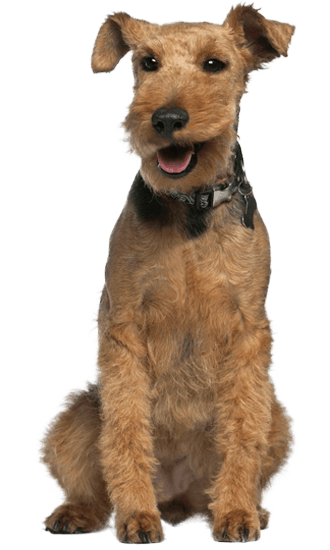
The Welsh Terrier is a very rectangular dog with a boxy head. He looks like a small Airedale Terrier. The back is very straight and level, parallel to the floor. The Welsh has v-shaped ears which fold forward on each side of the head. The head and muzzle are wide and flat like a three-dimensional rectangle.
The Welsh nose is black and the eyes are dark. The docked tail of the Welsh Terrier is carried high. If the tail is not docked, the dog carries it gaily but not curled over the back. Males have a mustache.
The Welsh Terrier is a very sturdy-looking dog, strong and muscular with a very alert expression.
Coat Color
The jacket is black, spreading up onto the neck, down onto the tail and into the upper thighs. The legs, quarters, and head are clear tan. The tan is a deep reddish color, with slightly lighter shades acceptable. A grizzle jacket is also acceptable.
Coat Type
The Welsh Terrier has a harsh wiry coat all over his body. Its hair is bristly and resistant to dampness. The wiry coat has a soft undercoat. This coat is not shed so needs to be ‘stripped’ by a professional groomer every 6-8 weeks.
Height: Maximum of 15.5 inches
Weight: Average weight of 20 – 21 lbs

Free Welsh Terrier Training Secrets
Free Course on Welsh Terrier Training & Obedience
Stop All Bad Behavior, Excessive Barking and Biting
Welsh Terrier Personality Traits

Temperament of the Dog
The Welsh Terrier if very energetic and active. He loves to play with children and can handle rough play. He is curious, happy, and spunky. An active family suits him well.
By socializing the Welsh Terrier well, you can avoid problems with timidity or aggressiveness. They can show dominance with other pets so should be introduced early.
Welsh Terriers often enjoy swimming. Most like to dig. Some are hard to housebreak (especially females).
A very intelligent and clever breed, the Welsh Terrier is smart enough to know what you want and outsmart you to divert you from your intentions.
They need variety but firmness and consistency in their training.
Better suited to an indoor or outdoor lifestyle?
The Welsh Terrier can live indoors as long as he gets plenty of outdoor play and work time. He could also live outdoors as long as the weather is not too hot or too cold and he gets plenty of time with his family.
Welsh Terriers are not recommended for apartment living as they are very active indoors and do not settle down as they age.
At least an average-sized, securely fenced yard is necessary for the Welsh.
Are they suited to homes with kids?
Welsh Terriers are great for homes with children as they have an endless amount of energy and love the rough and tumble of an active family.
Welsh Terrier Activity Level
How Active is the Breed?
This is a very high energy dog.
The Welsh Terrier is extremely active, but will get plenty of exercise inside playing ball and other games. He loves outdoor exercise but must do it within a fenced area or will chase anything that moves.
Walking, and perhaps jogging, can help him get enough exercise.
How Much Exercise Does the Dog Need at every stage of its Life?
Puppies, up to two years old or a bit older, often are very rambunctious. After two years, he settles down a bit but is still very active even in the house. He needs both mental and physical stimulation.
Do not take your Welsh running or jogging until he is at least one year old so that his bones and muscles are fully developed.
They love competition such as obedience or agility – and training for it.
Grooming
Frequent brushing is needed to keep mats from forming. Watch for burrs and debris. Bathing and brushing can be done at home on a regular basis but a complete grooming should be done professionally 4-6 times a year to keep the coat in proper shape. Owners can keep hair around eyes plucked so as to eliminate irritation or invite infection. Regular (daily) washing of the beard is advised to keep bacteria from food reduced that can promote gum disease and tooth loss. Trim hair on the feet between the pads.
Use a monthly flea and tick preventive.
Free Welsh Terrier Training Secrets
Free Course on Welsh Terrier Training & Obedience
Stop All Bad Behavior, Excessive Barking and Biting
Health and Care
Genetic Problems
A variety of eye and skin problems plague the Welsh. A very breed-specific issue is dry skin and many skin allergies. If this affects your Welsh, try an adjusted omega-6/omega-3 fatty acid ratio in the diet.
Litter Size: Average of 9 puppies
Life Span: 10 – 12 years
National Breed Clubs
National Breed Clubs
British – Welsh Terrier
Association – www.welshterrierassociation.co.uk
Welsh Terrier Club – www.welshterrierclub.co.uk
US – The Welsh Terrier Club of America, Inc.
- http://clubs.akc.org/wfca
Other Recognition: CKC, FCI, AKC, UKC, KCGB, CKC, ANKC, NKC, NZKC, CET, APRI, ACR
Rescue Link: www.wtcares.org/
Group: Terrier Group.
AKC Popularity Ranking: 107
Train Your Welsh Terrier To Listen To You
Get Instant Access to Your Training Now - For Free
Sign up for our Free Welsh Terrier Mini Course to have a housebroken, obedient dog that happily comes to you every time you call.
You'll learn new commands to obedience-train your dog as well as how to housebreak your dog in 6 days or less.
You'll also learn how to eliminate bad habits like barking, nipping or biting, jumping, or pulling on the leash.Here's just s small fraction of what else you'll learn in the course:
How to lead and think like a pack dog - the new psychology.
3 dangerous mistakes that most Welshie owners make when they are trying to potty train their dogs.
The 2 main reasons why your dog barks excessively and how to control its excessive barking.
How to obedience train your Welsh Terrier to permanently end behavioral problems like Jumping, Aggression, Pulling on Leash.
A surprisingly easy way to teach your dog cool new tricks.
How to improve your dog's lifespan and keep it from getting overly heavy with a healthy and nutritious diet.
Getting Pro help fast - how to get access to our expert trainers when you need them most.
One hidden psychological trigger that all Welsh Terriers have... that practically allows you to "analyze" and "control" your dog's every action.
Priority access to the free online seminars conducted by our training experts.
Whereas other dog training related web sites and books offer generic information for dogs in general, ours is the ONLY web site that offers Welshie information specifically, from a renowned panel of experts - because as you probably know, Welshies have their own special training requirements that other dogs don't have.




What Other Dog Owners Say…

Our Free Courses
Dog Obedience TrainingDog Housetraining
Stop Dog Barking
Stop Dog Biting
HomeMade Dog food
Dog Grooming
Adopting A Dog
Read More
PureBred Dog BreedsMixed Dog Breeds
Dog Groups
Training Small Dog Breeds
Training Medium Dog Breeds
Training Large Dog Breeds
Exercising Your Dog
Dog Health
More Articles
Dog Grooming Needs
Our Tribute