Privacy Policy: Your email address is 100% safe.
We don't spam and hate it as much as you do :-) You can also unsubscribe from our mailing list at any time.

Subscribe to The FREE Spanish Water Dog Training Course to learn how you can easily turn your unruly and disobedient Spanish Water Dog into a loving, friendly companion. Step-by-step tips for puppy housebreaking, dog obedience training and stopping bad behavior.
Sign Up
Sign Up
Spanish Water Dog: Temperament, Exercise, Health
About Spanish Water Dog
Country of Origin, History of Spanish Water Dogs
The exact origin of this ancient breed is not known. One theory suggests that the Turkish merchants brought the dog to the South Iberian Peninsula along with the flocks of livestock as they moved throughout the Mediterranean. Another theory suggests North African origin.
Spanish Water Dog Tools
Breed Selector Tool - is the Spanish Water Dog the right breed for you?
Is the Spanish Water Dog the right breed for you and your family?
Find out by using our Free Dog Breed Selector Tool
Check Your Spanish Water Dog's Learning Style
Are you aware dogs also have a learning style that can greatly affect their ability to housetrain as well as be trained correctly. Evaluate your Spanish Water Dog's learning style and personality using our free Learning Style tool so that you are better able to provide him with the proper Spanish Water Dog training methods.
Is your Spanish Water Dog dominating over you?
Does your Spanish Water Dog bark unnecessarily? Does your Spanish Water Dog come to you when you call? Download a FREE Report on Dog Dominance for you and your Spanish Water Dog and learn how to control your dog.
Do you make these mistakes with your Spanish Water Dog?
Are you inadvertently snow-balling bad behavior in your Spanish Water Dog? Evaluate your Dog Training Style from our Free Tool and learn how best to deal with your dog.
Spanish Water Dog Calorie Calculator
Do you know how many calories your Spanish Water Dog needs every day and how many cups of food you should be giving it every day? Click here to use our Spanish Water Dog Calorie Calculator.
A General Description of the Dog
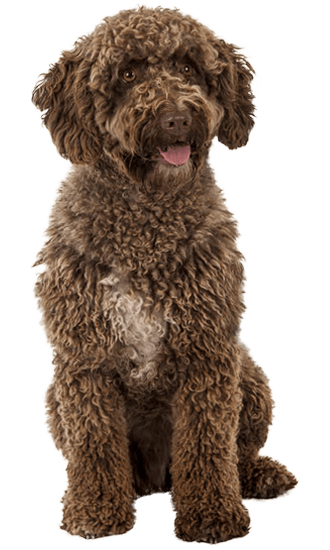
The Spanish Water Dog is rustic, well proportioned, of medium weight. The head is strong and carried with elegance. The eyes are slightly oblique position, very expressive. The body is robust and the topline straight. The tail is set at medium height.
Coat Type
The coat is always curly and of woolly texture.
Color
Coat color from Spanish Water Dogs include include white, black and chestnut in their different shades.
They can be Bicoloured: White and black or white and brown in their different shades.
They can be Tricoloured too. But black and tan, as well as hazelnut and tan dogs are not admitted.
Height
Males 17-20 inches (44 to 50 cm.)
Females 16-18 inches (40 to 46 cm.)
Weight
Males 40-49 pounds (18-22 kg.)
Females 30-40 pounds (14-18 kg.)

Free Spanish Water Dog Training Secrets
Free Course on Spanish Water Dog Training & Obedience
Stop All Bad Behavior, Excessive Barking and Biting
Spanish Water Dog Personality Traits
Temperament
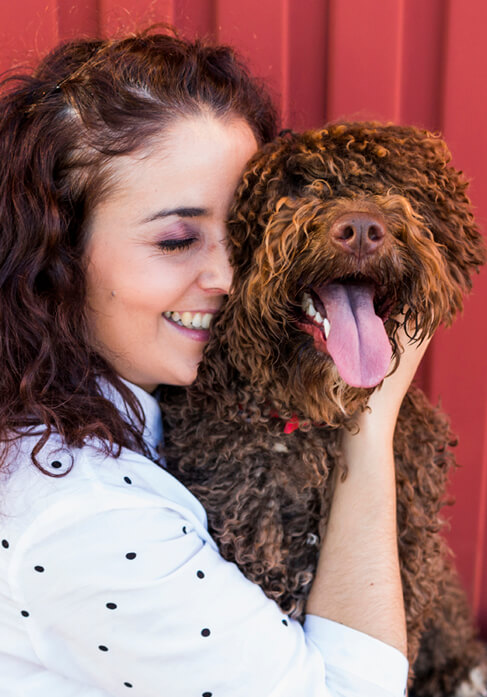
The Spanish Water Dog is an extremely intelligent, fearless, ever-active, strong, attentive, happy and well balanced versatile working dog with strong herding, hunting and guardian instincts. It is a devoted companion. It is reserved, not shy, with strangers. They can be protective and territorial.
Are they suited to families with kids?
Most of them are good with children and other animals if properly socialized.
Spanish Water Dog Activity Level
How active is the breed?
The Spanish Water Dog can adapt to almost all environments, circumstances and extreme climates, as long as it gets enough exercise.
The Spanish Water Dog should get plenty of exercise, which includes a daily walk. Young puppies should never be over-taxed, to avoid possible bone and joint problems. They become more active and sleep less as they mature and by the time they are a year old, these dogs have endless stamina and are very fast, athletic and agile. They have extraordinary learning ability and memory and are eager to learn.
Grooming
If meant to be a working dog, the coat should be sheared, never combed or brushed, but bathed only when necessary using a mild shampoo without heavy conditioners. If the coat becomes excessively matted, the cords can be separated by pulling the mats apart with the fingers down to the skin.
For show dogs, the coat should be sheared down at least once a year (or more). Once or twice a week one should look behind the ears, and the area where he sits and separate any cords that might bind together. Its nails should be clipped and eyes cleaned as often as necessary. Consistent minimal work is needed to help develop the proper cording.
The Spanish Water Dog does not shed its coat. If there are concerns about allergies, it is recommended that one spend time with the Spanish Water Dog to see if they are indeed allergic.
Free Spanish Water Dog Training Secrets
Free Course on Spanish Water Dog Training & Obedience
Stop All Bad Behavior, Excessive Barking and Biting
Health and Care
While the SWD seems to be a very healthy breed there are some issues that the SWD have, just like all other breeds. There are cases of Hip Dysplasia in the breed, so choose your breeder carefully.
All breeding dogs should have their hips tested, either by OFA or PennHIP. There have been a few cases of PRA reported in Europe so it is advised that all breeders should test their breeding stock for PRA and other such genetic eye diseases with a yearly CERF exam. A responsible breeder will be able to produce the results in writing.
Like other Water Dogs and related breeds, they grow hair in their ear canals and can be prone to ear infections. The ears must be kept dry and clean. . Because these dogs are (as a general rule) so active and energetic as puppies, they may seriously injure themselves from too much running and jumping when their skeletal structure is still developing.
National Breed Clubs
Life Expectancy: About 10-14 years.
Group: Herding Group
AKC Popularity Ranking: 153
Also Known As: Perro de Agua, Perro Turco, Laneto, Perro de Lanas, Perro Patero, Perro Rizado, Churro, Barbeta, and most recently, Perro de Agua Espanol
Train Your Spanish Water Dog To Listen To You
Get Instant Access to Your Training Now - For Free
Sign up for our Free Spanish Water Dog Mini Course to have a housebroken, obedient dog that happily comes to you every time you call.
You'll learn new commands to obedience-train your dog as well as how to housebreak your dog in 6 days or less.
You'll also learn how to eliminate bad habits like barking, nipping or biting, jumping, or pulling on the leash.Here's just s small fraction of what else you'll learn in the course:
How to lead and think like a pack dog - the new psychology.
3 dangerous mistakes that most Spanish Water Dog owners make when they are trying to potty train their dogs.
The 2 main reasons why your dog barks excessively and how to control its excessive barking.
How to obedience train your Spanish Water Dog to permanently end behavioral problems like Jumping, Aggression, Pulling on Leash.
A surprisingly easy way to teach your dog cool new tricks.
How to improve your dog's lifespan and keep it from getting overly heavy with a healthy and nutritious diet.
Getting Pro help fast - how to get access to our expert trainers when you need them most.
One hidden psychological trigger that all Spanish Water Dogs have... that practically allows you to "analyze" and "control" your dog's every action.
Priority access to the free online seminars conducted by our training experts.
Whereas other dog training related web sites and books offer generic information for dogs in general, ours is the ONLY web site that offers Spanish Water Dog information specifically, from a renowned panel of experts - because as you probably know, Spanish Water Dogs have their own special training requirements that other dogs don't have.




What Other Dog Owners Say…

Our Free Courses
Dog Obedience TrainingDog Housetraining
Stop Dog Barking
Stop Dog Biting
HomeMade Dog food
Dog Grooming
Adopting A Dog
Read More
PureBred Dog BreedsMixed Dog Breeds
Dog Groups
Training Small Dog Breeds
Training Medium Dog Breeds
Training Large Dog Breeds
Exercising Your Dog
Dog Health
More Articles
Dog Grooming Needs
Our Tribute