Privacy Policy: Your email address is 100% safe.
We don't spam and hate it as much as you do :-) You can also unsubscribe from our mailing list at any time.
Subscribe to The FREE Rhodesian Ridgeback Training Course to learn how you can easily turn your unruly and disobedient Rhodesian into a loving, friendly companion. Step-by-step tips for puppy housebreaking, dog obedience training and stopping bad behavior.
Sign Up
Sign Up
Rhodesian Ridgeback: Personality, Training, and Origin

About Rhodesian Ridgeback
Country of Origin, History of Rhodesian Ridgebacks
The Rhodesian Ridgeback, the only known breed to have originated in South Africa, is said to have descended from native ridged dogs crossed to various continental breeds. They combined Danes, Mastiffs, Greyhounds, Bloodhounds, Terriers, and other breeds with the half-wild Hottentot hunting breed to create the Ridgeback. Its standard, fixed in Rhodesia, dates from 1922.
It is not known definitely when this dog was first introduced into the United States. A few were imported prior to 1940, possibly as early as 1912. However, after World War II (between 1946 and 1955 -- when the breed was recognized by AKC), quite a large number of these dogs were imported, not only into the United States, but also into England and Canada.
Rhodesian Ridgeback Tools
Breed Selector Tool - is the Rhodesian Ridgeback the right breed for you?
Is the Rhodesian Ridgeback the right breed for you and your family?
Find out by using our Free Dog Breed Selector Tool
Check Your Rhodesian Ridgeback's Learning Style
Are you aware dogs also have a learning style that can greatly affect their ability to housetrain as well as be trained correctly. Evaluate your Rhodesian Ridgeback's learning style and personality using our free Learning Style tool so that you are better able to provide him with the proper Rhodesian Ridgeback training methods.
Is your Rhodesian Ridgeback dominating over you?
Does your Rhodesian Ridgeback bark unnecessarily? Does your Rhodesian Ridgeback come to you when you call? Download a FREE Report on Dog Dominance for you and your Rhodesian Ridgeback and learn how to control your dog.
Do you make these mistakes with your Rhodesian Ridgeback?
Are you inadvertently snow-balling bad behavior in your Rhodesian Ridgeback? Evaluate your Dog Training Style from our Free Tool and learn how best to deal with your dog.
Rhodesian Ridgeback Calorie Calculator
Do you know how many calories your Rhodesian Ridgeback needs every day and how many cups of food you should be giving it every day? Click here to use our Rhodesian Ridgeback Calorie Calculator.
A General Appearance of the Dog
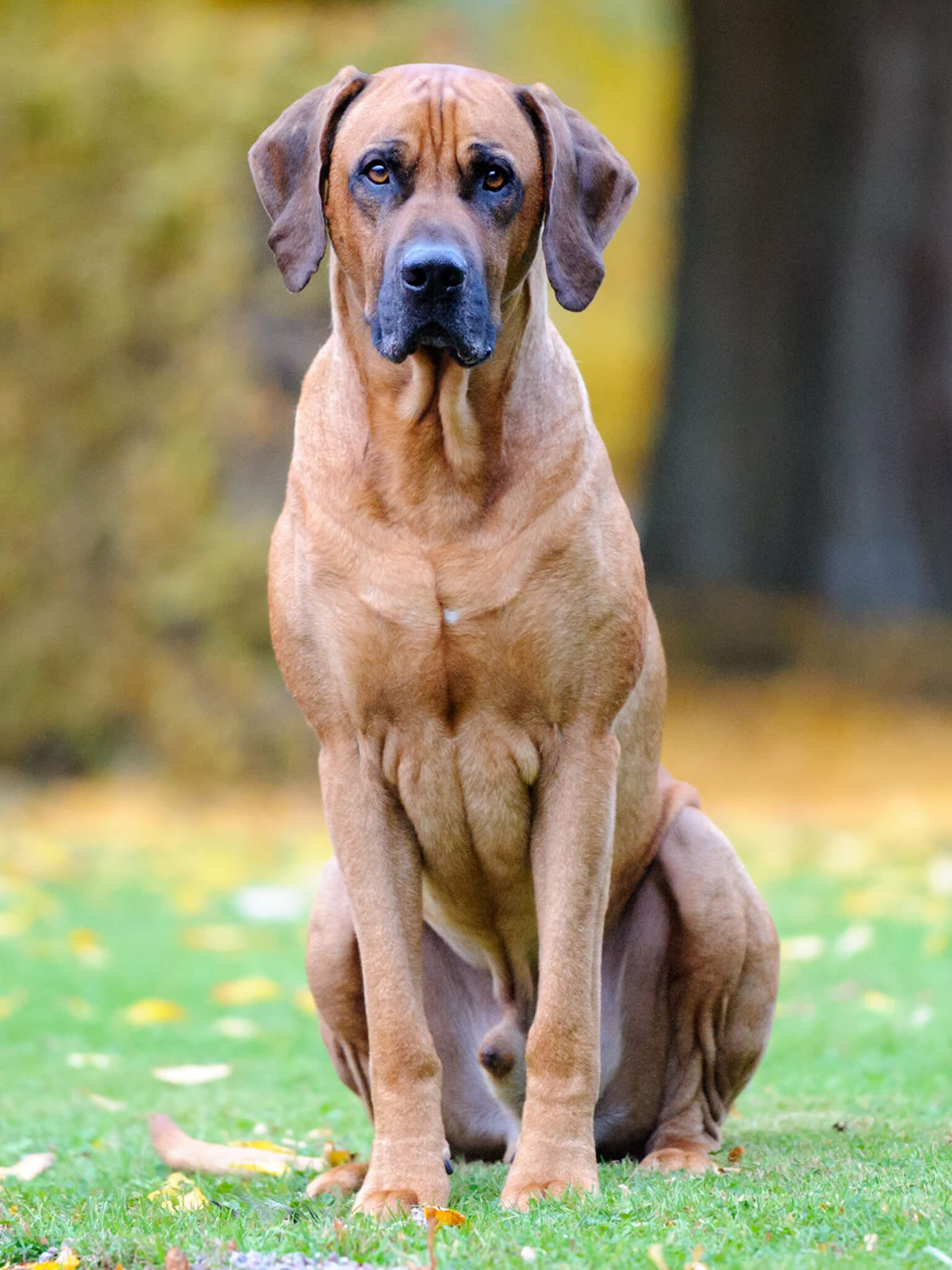
A Rhodesian Ridgeback is a large, tenacious, muscular, active dog, symmetrical in outline, and capable of great endurance. This tall, strong breed is solid in color with some dark grey or black shading on the muzzle and ears in some dogs. Their head is wide at the ears with a proportionately long muzzle. Their ears are large and soft and hang down. The tail is long and balances the height of the dog. Eyes are expressive and keenly aware of slight movements both near and far.
The ridge on his back is his trademark. It should be clearly defined by the hairs growing in the opposite direction to the rest of the coat.
Coat Color
Solid light or red wheaten body with same color nose, or black or brown nose. There is some dark grey or black shading on the muzzle and ears in some dogs.
Coat Type
This dog’s coat is short, dense, sleek and glossy.
Height
Males 25-27”
Females 24-26”
Weight
Males 80-90Lbs.
Females 65-75Lbs.

Free Rhodesian Ridgeback Training Secrets
Free Course on Rhodesian Ridgeback Training & Obedience
Stop All Bad Behavior, Excessive Barking and Biting
Rhodesian Ridgeback Personality Traits

Temperament of the Dog
This breeds are clean dogs, easily kept, and never noisy or quarrelsome. Their general good nature, desire to please and liking for children have made them a fine choice for watchdog and family pet. They have a pack instinct and need the closeness of family or other large pets to keep them happy. They can be very obedient if training is started early and reinforced. If, on the other hand, this large dog is not trained, he can become difficult and oblivious to your call.
As puppies they can be come quite destructive with their chewing and need to have special toys offered to keep them satisfied until this passes. Crate training Rhodesian Ridgebacks is highly recommended to keep both the dog and its surroundings safe until it matures.
They have a high regard for their home and territory and will keep it well patrolled and safe.
Better suited to an indoor or outdoor lifestyle?
Large yards are best for this breed but apartment living is not out of the question since they are quiet indoors. Regular walks on lead will be required if no yard is available and joggers would be delighted by their stamina.
The Ridgeback is an extremely clean dog with little odor and minimal shedding. Its short, dense coat sheds little. In general, a Ridgeback kept indoors sheds a little all year round, whereas an outside one will experience seasonal shedding. They do not drool, except in anticipation of food. They are generally easy to housetrain and are not overactive in the house. They will take over the furniture unless their owners discourage this habit from puppy hood. A happily wagging tail will easily clear a low coffee table of its contents.
Are they suited to homes with kids?
Intelligent, loyal and loving,
make this a great pet for families with children.
Their protective instincts make them good watchdogs
but can leave them distant to strangers.
They can be good with cats if brought up with them,
but fiercely effective in defending their territory
from stray dogs and cats. The Ridgeback is an excellent
natural watchdog and family protector, requiring
only that the owner has control over it.
Due to its large size, younger and more excitable Ridgebacks may knock over smaller children by accident.
Rhodesian Ridgeback Activity Level
How Active is the Breed?
These dogs have great stamina and you will tire long before they do. They need to be taken on daily, long and brisk walks or jogs. In addition, the breed needs plenty of opportunity to run, preferably off the leash in a safe, well-fenced area. If these dogs are allowed to get bored, and are not walked or jogged daily, they can become destructive and start to display a wide array of behavioral problems.
How Much Exercise Does the Dog Need at every stage of its Life?
When going through teething periods, at 6 weeks to about 4-½ months and again at around 8 to 10 months. Ridgebacks can be quite destructive if not provided with things that you want them to chew on, such as safe and fun toys, bones, a Kong® etc. Crate training may be essential in order to keep unsupervised, adolescent Ridgebacks in check.
Like any medium-large dog, Ridgebacks need exercise -- a daily romp in the back yard or park and a couple of longer trips to the park per week should be sufficient. More would be better, but Ridgebacks do adapt to their people.
Grooming
The smooth, short-haired coat is easy to groom. Brush with a firm bristle brush and shampoo only when necessary. A chamois will keep the coat glossy. Keep the nails clipped every two weeks if the dog is not walking on pavement. This breed is an average shedder, depending if it is outside most of the time or alternating from inside to outside.
Professional bathing may be required because of their size and weight and should be done when necessary.
Free Rhodesian Ridgeback Training Secrets
Free Course on Rhodesian Ridgeback Training & Obedience
Stop All Bad Behavior, Excessive Barking and Biting
Health and Care
Genetic Problems
The dog can withstand very high temperatures and the damp cold of night. They are insensitive to insect bites and can go without food and water for over 24 hours. Despite these strengths, the breed does suffer from Hip Dysplasia and Dermoid Sinus cysts.
Breeding the Dog and any Cautions
Consult with your breeder to determine the best breeding mate for your pet. Generally the breed is an easy and consistent whelper.
Litter Size: 5-10 puppies.
Life Span: 10-12 years
National Breed Clubs
National Breed Clubs
British – Rhodesian Ridgeback
Club of Great Britain
US – Rhodesian Ridgeback Club of the United
States - www.rrcus.org
Other Recognition: CKC, FCI, AKC, KCGB, CKC, ANKC, NKC, NZKC, RRCUSI, APRI, ACR
Rescue Link: www.ridgebackrescue.org/
Group: Hound Group.
AKC Popularity Ranking: 41
Also Known As: Ridgeback
Train Your Rhodesian Ridgeback To Listen To You
Get Instant Access to Your Training Now - For Free
Sign up for our Free Rhodesian Ridgeback Mini Course to have a housebroken, obedient dog that happily comes to you every time you call.
You'll learn new commands to obedience-train your dog as well as how to housebreak your dog in 6 days or less.
You'll also learn how to eliminate bad habits like barking, nipping or biting, jumping, or pulling on the leash.Here's just s small fraction of what else you'll learn in the course:
How to lead and think like a pack dog - the new psychology.
3 dangerous mistakes that most Rhodesian owners make when they are trying to potty train their dogs.
The 2 main reasons why your dog barks excessively and how to control its excessive barking.
How to obedience train your Rhodesian Ridgeback to permanently end behavioral problems like Jumping, Aggression, Pulling on Leash.
A surprisingly easy way to teach your dog cool new tricks.
How to improve your dog's lifespan and keep it from getting overly heavy with a healthy and nutritious diet.
Getting Pro help fast - how to get access to our expert trainers when you need them most.
One hidden psychological trigger that all Rhodesian Ridgebacks have... that practically allows you to "analyze" and "control" your dog's every action.
Priority access to the free online seminars conducted by our training experts.
Whereas other dog training related web sites and books offer generic information for dogs in general, ours is the ONLY web site that offers Rhodesian information specifically, from a renowned panel of experts - because as you probably know, Rhodesians have their own special training requirements that other dogs don't have.




What Other Dog Owners Say…

Our Free Courses
Dog Obedience TrainingDog Housetraining
Stop Dog Barking
Stop Dog Biting
HomeMade Dog food
Dog Grooming
Adopting A Dog
Read More
PureBred Dog BreedsMixed Dog Breeds
Dog Groups
Training Small Dog Breeds
Training Medium Dog Breeds
Training Large Dog Breeds
Exercising Your Dog
Dog Health
More Articles
Dog Grooming Needs
Our Tribute