Privacy Policy: Your email address is 100% safe.
We don't spam and hate it as much as you do :-) You can also unsubscribe from our mailing list at any time.
Subscribe to The FREE Newfoundland Training Course to learn how you can easily turn your unruly and disobedient Newfie into a loving, friendly companion. Step-by-step tips for puppy housebreaking, dog obedience training and stopping bad behavior.
Sign Up
Sign Up
Newfoundland: Training, Temperament, Exercise, Grooming, Health (Newfie, Newf)
About Newfoundland
Country of Origin, History of Newfoundlands
The origin of the Newfoundland is uncertain. Some stories have it descended from the Nordic ‘bear dogs’. Another story says he came from the Great Pyrenees that were brought to the coast of Newfoundland by Basque fishermen. In any case, much of his development happened in Newfoundland.
The Newfoundland’s coat is heavy to protect him from long winters and icy waters. His webbed feet allowed him to travel the marshes or to swim.
Later taken to England, many of the Newfoundlands seen today are from those.
Newfoundlands are famous for their water rescues. Their size and strength allow them to rescue drowning men. The Newfie’s intelligence tells him when there is trouble and how to react.
They also drag carts and carry burdens similar to pack horses. Their sweet compliance, loyalty and willingness to work and please complement their strength and agility.
Newfoundland Tools
Breed Selector Tool - is the Newfoundland the right breed for you?
Is the Newfoundland the right breed for you and your family?
Find out by using our Free Dog Breed Selector Tool
Check Your Newfoundland's Learning Style
Are you aware dogs also have a learning style that can greatly affect their ability to housetrain as well as be trained correctly. Evaluate your Newfoundland's learning style and personality using our free Learning Style tool so that you are better able to provide him with the proper Newfoundland training methods.
Is your Newfoundland dominating over you?
Does your Newfoundland bark unnecessarily? Does your Newfoundland come to you when you call? Download a FREE Report on Dog Dominance for you and your Newfoundland and learn how to control your dog.
Do you make these mistakes with your Newfoundland?
Are you inadvertently snow-balling bad behavior in your Newfoundland? Evaluate your Dog Training Style from our Free Tool and learn how best to deal with your dog.
Newfoundland Calorie Calculator
Do you know how many calories your Newfoundland needs every day and how many cups of food you should be giving it every day? Click here to use our Newfoundland Calorie Calculator.
A General Appearance of the Dog
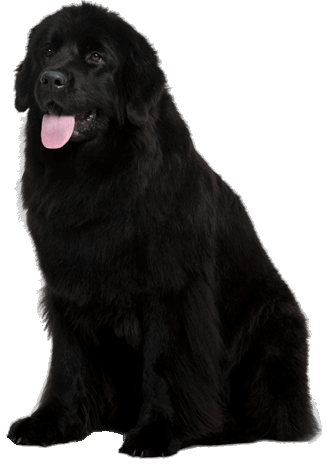
A Newfoundland is a stately, huge dog that should show balance. Although they are one of the giant dogs, they are elegant, agile, and very hardy. Large-boned and heavily coated, the Newfoundland is deep-chested, muscular, and very strong.
When seen from a distance, Newfies look like a black bear and they even walk with a lumbering gait like a bear. They have massive heads with smaller ears that expected. The large feet are webbed for swimming. The feathered tail hangs down, but is often wagging. The legs are also feathered. The body is covered with fairly long black or brown outercoat and thick undercoat which mats easily.
Coat Color
Coat colors can be black, brown, gray, or white and black. Black is most often seen.
Markings can be white on the chin, chest, toes, and tip of tail. There can be a tinge of bronze on a black or gray coat and some lighter furnishings on a brown or gray coat.
Landseer is a white base coat with black markings. In this coloring the head is solid black or black with white on the muzzle with or without a blaze. Usually this includes a black saddle and black on the rump.
Coat Type
The Newfoundland coat is a flat, water-resistant outercoat with a soft, dense undercoat. The outercoat is coarse, long, and full. It can be straight or wavy. The legs are heavily feathered and the tail is covered with long, dense hair.
Height
Males: 28 inches
Females: 26 inches
Weight
Males: 130 – 150 lbs
Females: 100 – 120 lbs

Free Newfoundland Training Secrets
Free Course on Newfoundland Training & Obedience
Stop All Bad Behavior, Excessive Barking and Biting
Newfoundland Personality Traits
Temperament of the Dog
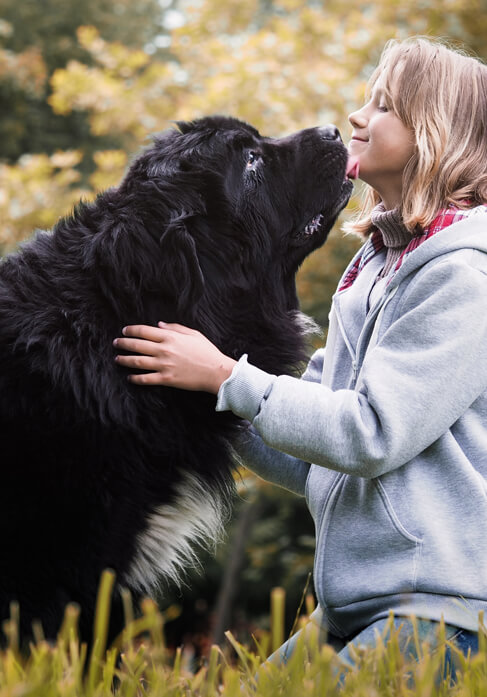
Although massive, the Newfoundland one of the calmest, sweetest dogs you will ever find. He is patient and willing to please. He has nearly every good trait you can think of to describe a dog – courageous, intelligent, generous, calm, gentle, loyal, trustworthy, dignified, devoted, sociable and peaceable. He is good with other animals if thoroughly socialized.
The Newfie protects his family by placing himself between them and the perceived danger.
His barking is more friendly than ferocious.
A devoted companion who is at home on land and in the water, the Newfoundland loves water so much he will probably play in his water bowl, your swimming pool, a creek, or the hose.
Do not let him laze around the house. They love socialization but may tend to be lazy when obedience trained (which is necessary because of their size).
Better suited to an indoor or outdoor lifestyle?
He enjoys being outdoors especially if it is cool. Hot weather is hard on him so make sure he has plenty of shade and cool water. Do not leave him outside alone for hours on end. He loves to be with his family.
Are they suited to homes with kids?
He is playful and loving with children of all ages. He is considered a 'born babysitter.'
Newfoundland Activity Level
How Active is the Breed?
A Newfie will do fine in an apartment or with a small yard if he has a long walk each day. Do not let him laze around the house. They love socialization but may tend to be lazy when obedience trained (which is necessary because of their size).
How Much Exercise Does the Dog Need at every stage of its Life?
As a puppy, a Newfoundland will want play times and walks. As he matures, he will tend to be lazy and enjoy just lying around and watching the action. However, he needs to get up and move around – take a walk, play at a dog park, or play with another dog.
Grooming
They shed heavily twice a year and moderately the rest of the year. They must be brushed at least weekly, but it is better to brush them about every three days. Their coats mat easily. They are fairly heavy shedders. Do not bathe unless absolutely necessary as that strips the coat’s oils.
Because of their size, a professional groomer may be helpful in spring and fall.
Free Newfoundland Training Secrets
Free Course on Newfoundland Training & Obedience
Stop All Bad Behavior, Excessive Barking and Biting
Health and Care
Genetic Problems
Carrying extra weight will add to their problems with heart and joints. They are prone to hip dysplasia and hereditary heart disease called subaortic stenosis.
Litter Size: 4 – 8 puppies
Life Span: The life span of the Newfoundland varies from 9 to 15 years with most living about 10 – 11 years.
National Breed Clubs
National Breed Clubs
British – Newfoundland Club
- www.thenewfoundlandclub.co.uk
US – Newfoundland Dog Club - www.newfdogclub.org
Other Recognition: NCA, CKC, FCI, AKC, UKC, KCGB, CKC, ANKC, NKC, NZKC, APRI, ACR
Rescue Link
http://clubs.akc.org/NBC/Newfoundland_rescue.htm
or
http://www.brewNewfoundlands.org/giving-up.php
Group: Working Group
AKC Popularity Ranking: 40
Also Known As: Newfie.
Train Your Newfoundland To Listen To You
Get Instant Access to Your Training Now - For Free
Sign up for our Free Newfoundland Mini Course to have a housebroken, obedient dog that happily comes to you every time you call.
You'll learn new commands to obedience-train your dog as well as how to housebreak your dog in 6 days or less.
You'll also learn how to eliminate bad habits like barking, nipping or biting, jumping, or pulling on the leash.Here's just s small fraction of what else you'll learn in the course:
How to lead and think like a pack dog - the new psychology.
3 dangerous mistakes that most Newfie owners make when they are trying to potty train their dogs.
The 2 main reasons why your dog barks excessively and how to control its excessive barking.
How to obedience train your Newfoundland to permanently end behavioral problems like Jumping, Aggression, Pulling on Leash.
A surprisingly easy way to teach your dog cool new tricks.
How to improve your dog's lifespan and keep it from getting overly heavy with a healthy and nutritious diet.
Getting Pro help fast - how to get access to our expert trainers when you need them most.
One hidden psychological trigger that all Newfoundlands have... that practically allows you to "analyze" and "control" your dog's every action.
Priority access to the free online seminars conducted by our training experts.
Whereas other dog training related web sites and books offer generic information for dogs in general, ours is the ONLY web site that offers Newfie information specifically, from a renowned panel of experts - because as you probably know, Newfies have their own special training requirements that other dogs don't have.




What Other Dog Owners Say…

Our Free Courses
Dog Obedience TrainingDog Housetraining
Stop Dog Barking
Stop Dog Biting
HomeMade Dog food
Dog Grooming
Adopting A Dog
Read More
PureBred Dog BreedsMixed Dog Breeds
Dog Groups
Training Small Dog Breeds
Training Medium Dog Breeds
Training Large Dog Breeds
Exercising Your Dog
Dog Health
More Articles
Dog Grooming Needs
Our Tribute