Privacy Policy: Your email address is 100% safe.
We don't spam and hate it as much as you do :-) You can also unsubscribe from our mailing list at any time.
Subscribe to The FREE Lakeland Terrier Training Course to learn how you can easily turn your unruly and disobedient Lakeland Terrier into a loving, friendly companion. Step-by-step tips for puppy housebreaking, dog obedience training and stopping bad behavior.
Sign Up
Sign Up
Lakeland Terrier: Temperament, Exercise, Health
About Lakeland Terrier
Country of Origin, History of Lakeland Terriers
The Lakeland Terrier’s purpose was to hunt and kill vermin who live in dens such as badger and fox (and otter) in the rugged mountains of the Lake District of northern England. Originally called the Pattersday Terrier, the Lakeland Terrier was developed by breeding Bedlington Terriers and English Wirehaired Terriers. He has great hunting skills in water as well as uneven terrain.
Lakeland Terriers are great hunters and trackers. They make good watchdogs. They love and excel at competitive obedience and agility.
Lakeland Terrier Tools
Breed Selector Tool - is the Lakeland Terrier the right breed for you?
Is the Lakeland Terrier the right breed for you and your family?
Find out by using our Free Dog Breed Selector Tool
Check Your Lakeland Terrier's Learning Style
Are you aware dogs also have a learning style that can greatly affect their ability to housetrain as well as be trained correctly. Evaluate your Lakeland Terrier's learning style and personality using our free Learning Style tool so that you are better able to provide him with the proper Lakeland Terrier training methods.
Is your Lakeland Terrier dominating over you?
Does your Lakeland Terrier bark unnecessarily? Does your Lakeland Terrier come to you when you call? Download a FREE Report on Dog Dominance for you and your Lakeland Terrier and learn how to control your dog.
Do you make these mistakes with your Lakeland Terrier?
Are you inadvertently snow-balling bad behavior in your Lakeland Terrier? Evaluate your Dog Training Style from our Free Tool and learn how best to deal with your dog.
Lakeland Terrier Calorie Calculator
Do you know how many calories your Lakeland Terrier needs every day and how many cups of food you should be giving it every day? Click here to use our Lakeland Terrier Calorie Calculator.
A General Appearance of the Dog
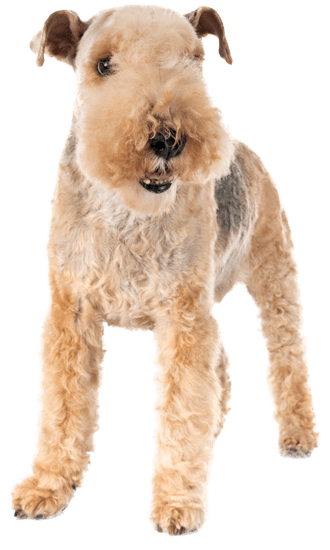
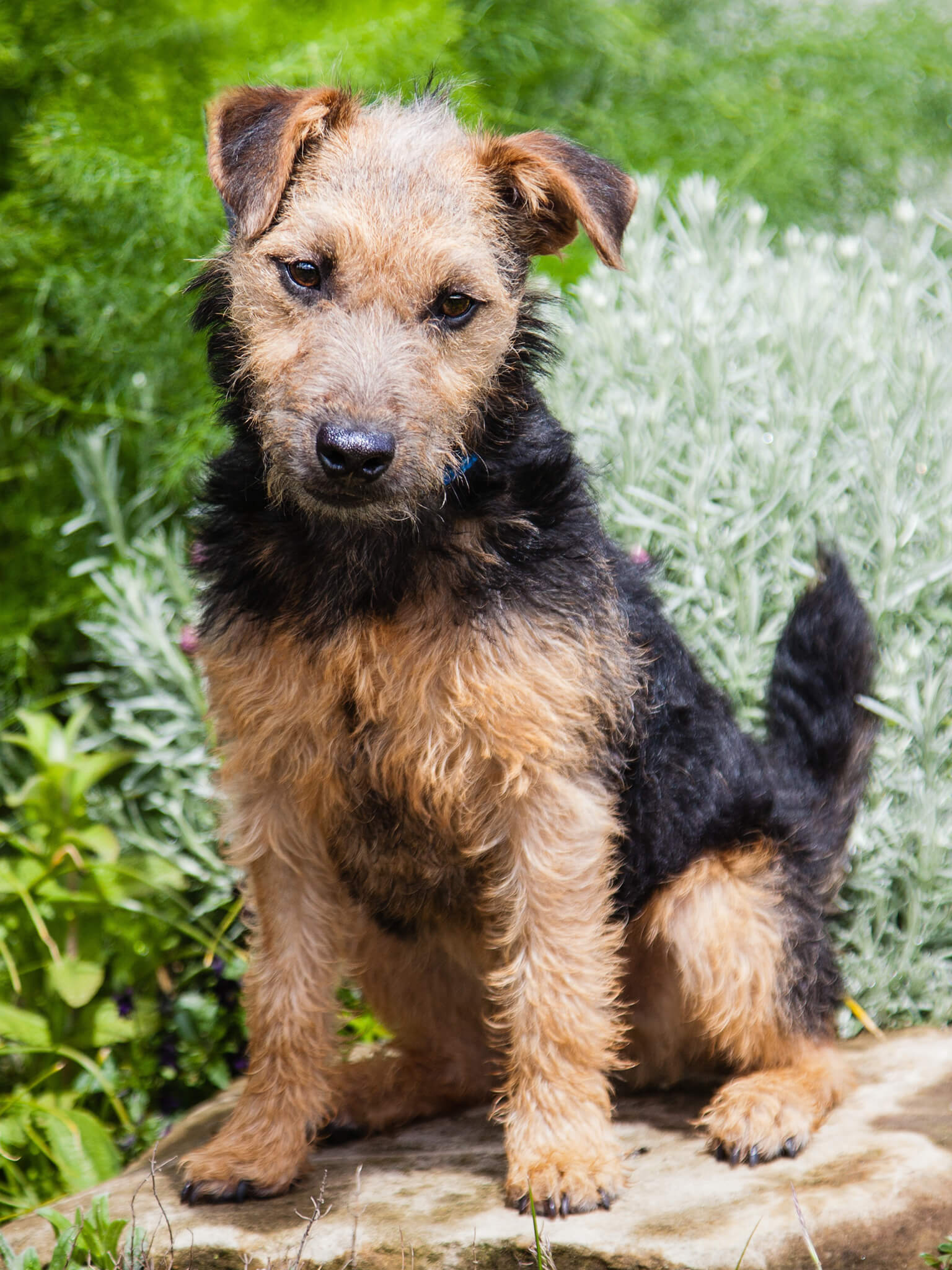
The Lakeland Terrier is a very rectangular dog with a boxy head. The long head has bushy hair on the face. The back is very straight and level, parallel to the floor. The Lakeland Terrier has v-shaped ears which fold forward on each side of the head. The head and muzzle are wide and flat like a three-dimensional rectangle.
The Lakeland Terrier’s nose is dark and the eyes are dark. The docked tail of the Lakeland Terrier is carried high. If the tail is not docked, the dog carries it gaily but not curled over the back. Males have a mustache.
The Lakeland Terrier is a very sturdy-looking dog, strong and muscular with a very alert expression. The legs are straight and sturdy. This terrier looks like he is standing on his toes. His body is not robust as it is built for working and his legs, although well-muscled, are long to cover ground quickly. This dog looks like a smaller version of an Airedale Terrier.
Coat Color
Lakeland Terrier puppies are often dark-colored when born. Various colors for the Lakeland Terrier are black, black and tan, reddish, red grizzle, wheat, liver and blue, and grizzle and tan. There may or may not be a saddle.
Coat Type
The Lakeland Terrier has a harsh wiry coat all over his body with an softer undercoat.
Height: Ideally no more than 14.5 inches
Weight: Ideally around 17 lbs for males and 15 lbs for females

Free Lakeland Terrier Training Secrets
Free Course on Lakeland Terrier Training & Obedience
Stop All Bad Behavior, Excessive Barking and Biting
Lakeland Terrier Personality Traits

Temperament of the Dog
The Lakeland Terrier is a clever, adventurous, mischievous, playful dog. Cheerful and peppy, affectionate and loving, he can also be feisty and determinedly willful when he wants to be. The Lakeland shows great courage that goes beyond confidence.
Lakeland Terriers like to dig, so be sure to secure the fence below the ground. They also tend to be barkers and need to be trained early to stop barking on command. They guard their toys and food fiercely.
Although difficult to housebreak, they train to walk on lead fairly easily. They love to please, so obedience training is not too difficult. However, training needs to start early, continue consistently, and be mixed with play and games so there is a challenge.
Unlike many terriers, the Lakeland gets along well with other dogs. He may be reserved with strangers. If they are to live with cats and other pets, they need to be socialized with them early so they do not chase them.
They make good watchdogs. They love and excel at competitive obedience and agility.
Better suited to an indoor or outdoor lifestyle?
Lakeland Terriers need to live in the house.
Are they suited to homes with kids?
Lakeland Terriers love children and enjoy playing with them.
Lakeland Terrier Activity Level
How Active is the Breed?
The Lakeland Terrier is very active indoors. He likes a yard but it is not necessary as long as he gets short walks through the day.
How Much Exercise Does the Dog Need at every stage of its Life?
Puppies are more active than adults. Adults and puppies are very active indoors, so once or twice weekly romps outdoors in a safe area such as a fenced yard or dog park are sufficient.
The Lakeland enjoys daily, long walks or jogs and is a suitable dog for running alongside you as you bicycle. He loves to play catch, fetch, Frisbee®, etc. Agility training will also keep him exercised and help his mind stay busy.
The Lakeland Terrier is a fine dog for apartment living.
Grooming
The Lakeland Terrier will need to have his coat hand plucked 2 -3 times a year by a professional groomer. Monthly removal of loose hair by brushing, removal of hair from ear passages, and trimming of toenails and foot hair will be needed. Use monthly flea and tick preventive.
Free Lakeland Terrier Training Secrets
Free Course on Lakeland Terrier Training & Obedience
Stop All Bad Behavior, Excessive Barking and Biting
Health and Care
Genetic Problems
This is a very hardy breed with no known genetic or health problems.
Breeding the Dog and any Cautions
Your breeder should be consulted on what mate would be a good match for your Lakeland Terrier.
Life Span: 10 – 12 years
Because of the good health and genetics of the breed, many survive for 15-16 years.
National Breed Clubs
National Breed Clubs
British - Lakeland Terrier Club,
Lakeland Terrier Society
US – United States Lakeland Terrier Club -
http://uslakelandterrier.org
Other Recognition: CKC, FCI, AKC, KCGB, CKC, ANKC, NKC, NZKC, CET, APRI, ACR
Rescue Link: http://uslakelandterrier.org/Default.aspx?tabid=66
Group: Terrier Group
AKC Popularity Ranking: 147
Train Your Lakeland Terrier To Listen To You
Get Instant Access to Your Training Now - For Free
Sign up for our Free Lakeland Terrier Mini Course to have a housebroken, obedient dog that happily comes to you every time you call.
You'll learn new commands to obedience-train your dog as well as how to housebreak your dog in 6 days or less.
You'll also learn how to eliminate bad habits like barking, nipping or biting, jumping, or pulling on the leash.Here's just s small fraction of what else you'll learn in the course:
How to lead and think like a pack dog - the new psychology.
3 dangerous mistakes that most Lakeland Terrier owners make when they are trying to potty train their dogs.
The 2 main reasons why your dog barks excessively and how to control its excessive barking.
How to obedience train your Lakeland Terrier to permanently end behavioral problems like Jumping, Aggression, Pulling on Leash.
A surprisingly easy way to teach your dog cool new tricks.
How to improve your dog's lifespan and keep it from getting overly heavy with a healthy and nutritious diet.
Getting Pro help fast - how to get access to our expert trainers when you need them most.
One hidden psychological trigger that all Lakeland Terriers have... that practically allows you to "analyze" and "control" your dog's every action.
Priority access to the free online seminars conducted by our training experts.
Whereas other dog training related web sites and books offer generic information for dogs in general, ours is the ONLY web site that offers Lakeland Terrier information specifically, from a renowned panel of experts - because as you probably know, Lakeland Terriers have their own special training requirements that other dogs don't have.




What Other Dog Owners Say…

Our Free Courses
Dog Obedience TrainingDog Housetraining
Stop Dog Barking
Stop Dog Biting
HomeMade Dog food
Dog Grooming
Adopting A Dog
Read More
PureBred Dog BreedsMixed Dog Breeds
Dog Groups
Training Small Dog Breeds
Training Medium Dog Breeds
Training Large Dog Breeds
Exercising Your Dog
Dog Health
More Articles
Dog Grooming Needs
Our Tribute