Privacy Policy: Your email address is 100% safe.
We don't spam and hate it as much as you do :-) You can also unsubscribe from our mailing list at any time.
Subscribe to The FREE Komondor Training Course to learn how you can easily turn your unruly and disobedient Komondor into a loving, friendly companion. Step-by-step tips for puppy housebreaking, dog obedience training and stopping bad behavior.
Sign Up
Sign Up
Komondor: Key Characteristics of Komondor Dog Breed
About Komondor
Country of Origin, History of Komondors
The Komondor is descended from Tibetan dogs. Newer studies show they came from the Cumans, the Turkic speaking nomadic tribe who settled in Hungary in 12th and 13th century. In fact the word "Komondor" means the dog of Cumans.
The Komondor is believed to be related to the Ovcharka, the Puli, the Pumi, the Bearded Collie and the Old English Sheepdog.
It is believed that many Komondors got killed during the World War II because when the Germans or Russians invaded Hungary, they had to first kill the dog before they could capture the farm or the house they were protecting.
Komondor Tools
Breed Selector Tool - is the Komondor the right breed for you?
Is the Komondor the right breed for you and your family?
Find out by using our Free Dog Breed Selector Tool
Check Your Komondor's Learning Style
Are you aware dogs also have a learning style that can greatly affect their ability to housetrain as well as be trained correctly. Evaluate your Komondor's learning style and personality using our free Learning Style tool so that you are better able to provide him with the proper Komondor training methods.
Is your Komondor dominating over you?
Does your Komondor bark unnecessarily? Does your Komondor come to you when you call? Download a FREE Report on Dog Dominance for you and your Komondor and learn how to control your dog.
Do you make these mistakes with your Komondor?
Are you inadvertently snow-balling bad behavior in your Komondor? Evaluate your Dog Training Style from our Free Tool and learn how best to deal with your dog.
Komondor Calorie Calculator
Do you know how many calories your Komondor needs every day and how many cups of food you should be giving it every day? Click here to use our Komondor Calorie Calculator.
A General Appearance of the Dog
Komondors have robust bodies which are strongly muscled. They have long legs and a short back. The tail is carried with a slight cur.
The head and muzzle are massive and rather short. Its eyes are dark brown and the U-shaped ears hang down to blend with the rest of the coat.
Coat:
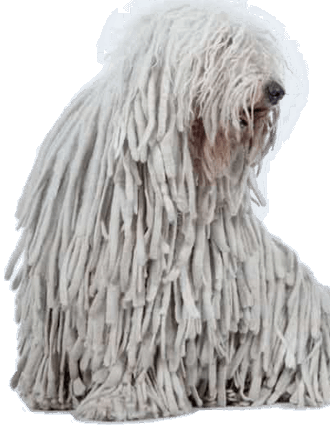
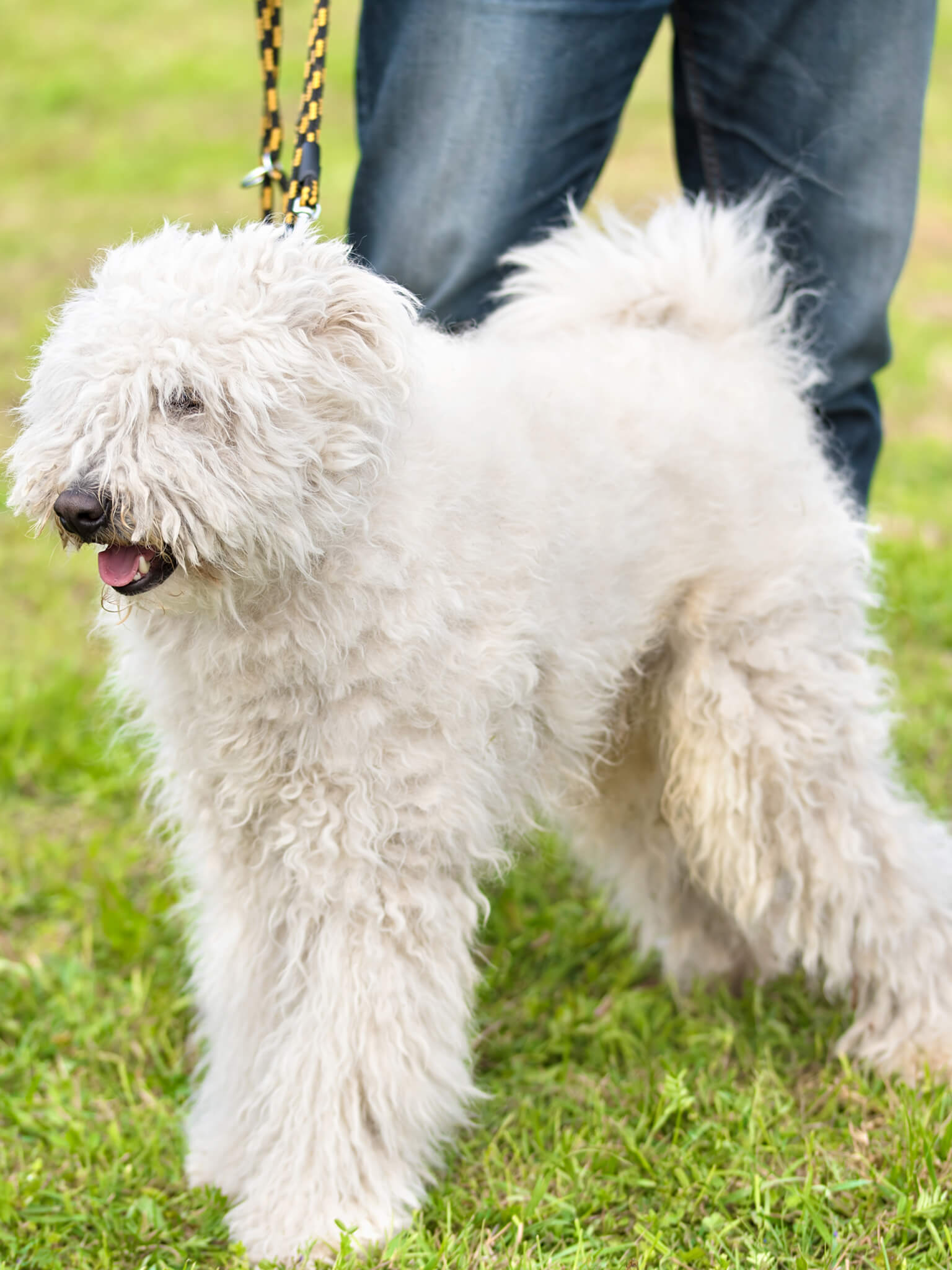
Its massive body is totally covered with an extraordinary felted and corded coat, which is 8 to 11 inches (20-27cm.) long, corded and always white, resembling dreadlocks or a mop. The outer coat fuses with the undercoat to form felt that hangs in long cords. It can take up to two years for the cords to form completely and 5 years to reach the desired length.
Height: 25.5 inches (65cm.) and upward.
Weight
Dogs up to 125 pounds (59kg.);
Bitches 10% less.

Free Komondor Training Secrets
Free Course on Komondor Training & Obedience
Stop All Bad Behavior, Excessive Barking and Biting
Komondor Personality Traits
Temperament of the Dog
The Komondor is serious, strong, confident, alert and commanding. It can be very reserved with strangers and is very territorial and highly protective of his family, house, car, and livestock. Implacable against wolves and bears that would attack the flock with which it is entrusted. Smart, but easily bored, loyal to and respectful of his master. Komondors can be good family dogs if they are socialized and trained thoroughly from puppyhood.
This dog does best in a clean country environment where he can receive extensive daily exercise, but it will do okay in an apartment if sufficiently exercised, though not recommended for most families They do well in most climates.
Exercise & Training
If they are not actively working as a flock guardian, they need to be taken on a daily, long brisk walk. This dog can be extremely lazy and will sleep and rest for hours upon hours. They need complete and firm obedience training by an experienced owner, as he can be very willful.
Grooming
Their hair must never be brushed or combed. It is divided into cords and trimmed. Its coat needs a lot of bathing and takes a long time to dry. A skin check for fleas or ticks should be part of a regular grooming routine. The hair should be cut out with an electric clipper or scissors to keep mats from forming between the foot-pads. It is especially necessary to keep the ears clean and hair-free. Once cords are fully formed, shedding is minimal.
Free Komondor Training Secrets
Free Course on Komondor Training & Obedience
Stop All Bad Behavior, Excessive Barking and Biting
Health and Care
They are prone to hip dysplasia
(though not overly common), bloat and skin problems.
Life Expectancy:
About 10-12 years.
National Breed Clubs
Breed Club: http://clubs.akc.org/kca/
Rescue Link: http://clubs.akc.org/kca/kca.htm
Group: Working Group
AKC Popularity Ranking: 173
Also Known As: Hungarian Komondor, Hungarian Sheepdog
Train Your Komondor To Listen To You
Get Instant Access to Your Training Now - For Free
Sign up for our Free Komondor Mini Course to have a housebroken, obedient dog that happily comes to you every time you call.
You'll learn new commands to obedience-train your dog as well as how to housebreak your dog in 6 days or less.
You'll also learn how to eliminate bad habits like barking, nipping or biting, jumping, or pulling on the leash.Here's just s small fraction of what else you'll learn in the course:
How to lead and think like a pack dog - the new psychology.
3 dangerous mistakes that most Komondor owners make when they are trying to potty train their dogs.
The 2 main reasons why your dog barks excessively and how to control its excessive barking.
How to obedience train your Komondor to permanently end behavioral problems like Jumping, Aggression, Pulling on Leash.
A surprisingly easy way to teach your dog cool new tricks.
How to improve your dog's lifespan and keep it from getting overly heavy with a healthy and nutritious diet.
Getting Pro help fast - how to get access to our expert trainers when you need them most.
One hidden psychological trigger that all Komondors have... that practically allows you to "analyze" and "control" your dog's every action.
Priority access to the free online seminars conducted by our training experts.
Whereas other dog training related web sites and books offer generic information for dogs in general, ours is the ONLY web site that offers Komondor information specifically, from a renowned panel of experts - because as you probably know, Komondors have their own special training requirements that other dogs don't have.




What Other Dog Owners Say…

Our Free Courses
Dog Obedience TrainingDog Housetraining
Stop Dog Barking
Stop Dog Biting
HomeMade Dog food
Dog Grooming
Adopting A Dog
Read More
PureBred Dog BreedsMixed Dog Breeds
Dog Groups
Training Small Dog Breeds
Training Medium Dog Breeds
Training Large Dog Breeds
Exercising Your Dog
Dog Health
More Articles
Dog Grooming Needs
Our Tribute