Privacy Policy: Your email address is 100% safe.
We don't spam and hate it as much as you do :-) You can also unsubscribe from our mailing list at any time.

Subscribe to The FREE Great Dane Training Course to learn how you can easily turn your unruly and disobedient Great Dane into a loving, friendly companion. Step-by-step tips for puppy housebreaking, dog obedience training and stopping bad behavior.
Sign Up
Sign Up
Great Dane: Characteristics, Grooming, Health, Training (German Mastiff)
About Great Dane
Country of Origin, History of Great Danes
Great Danes have a long history. Greek coins from 36 BC carry the image of a dog similar to the Great Dane. It has been called the “Apollo of all dogs.” Similar dogs were used by the Asiatic people called the Alans who invaded Germany, Italy, and Spain in 407 AD.
In Germany these magnificent animals were selectively bred to overcome bears and wild boars. Eventually they were crossed with Irish Greyhounds and the result was a thin, tall, agile dog known today as the Great Dane.
This dog does not come from Denmark.
This breeds are used for tracking, watchdog duties, and carting.
Great Dane Tools
Breed Selector Tool - is the Great Dane the right breed for you?
Is the Great Dane the right breed for you and your family?
Find out by using our Free Dog Breed Selector Tool
Check Your Great Dane's Learning Style
Are you aware dogs also have a learning style that can greatly affect their ability to housetrain as well as be trained correctly. Evaluate your Great Dane's learning style and personality using our free Learning Style tool so that you are better able to provide him with the proper Great Dane training methods.
Is your Great Dane dominating over you?
Does your Great Dane bark unnecessarily? Does your Great Dane come to you when you call? Download a FREE Report on Dog Dominance for you and your Great Dane and learn how to control your dog.
Do you make these mistakes with your Great Dane?
Are you inadvertently snow-balling bad behavior in your Great Dane? Evaluate your Dog Training Style from our Free Tool and learn how best to deal with your dog.
Great Dane Calorie Calculator
Do you know how many calories your Great Dane needs every day and how many cups of food you should be giving it every day? Click here to use our Great Dane Calorie Calculator.
A General Appearance of the Dog
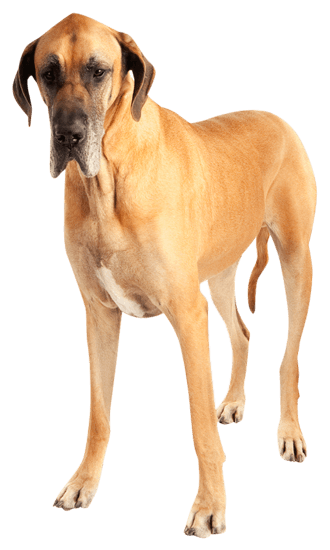
Elegant and noble, the dog is one of the tallest breeds. A powerfully muscular body, long neck, rectangular head with a long face and a large nasal canal, and tall pointed ears give the dog an unforgettable silhouette. His expression is intelligent and lively. His ears can be cropped long or left natural. He has a medium length tail.
Coat Color
The dog’s coat can be fawn, brindle, black, blue, mantle harlequin and even merle. Dark coated Danes have dark eyes while light coated Danes have lighter eyes. Brindle is yellow gold brindled with strong black cross stripes in a chevron pattern with a black mask and black eye rims and eyebrows. Black may appear on the tail and ear tips. Fawn is a yellow gold with a black mask, black eye rims and eyebrows. Blue is a pure steel blue all over. Black should be glossy black all over. Harlequin is a base color of pure white with black torn patches distributed over the body. Mantle is black and white with a solid black blanket extending over the body, a black skull with white muzzle, and often a white blaze, white color, white chest, white on the legs and/or tail.
Coat Type
This dog coat is short, thick, shiny, and close-fitting. His coat is smooth and glossy. His skin is tight with no wrinkles.
Height
Male: not less than 30 inches, preferably 32 inches or more as long as he is well-proportioned
Female: not less than 28 inches, preferably 30 inches or more as long as she is well-proportioned
Weight
Male: 120 to 200 lbs
Female: 100 to 130 lbs
Larger dogs are more valued.

Free Great Dane Training Secrets
Free Course on Great Dane Training & Obedience
Stop All Bad Behavior, Excessive Barking and Biting
Great Dane Personality Traits
Temperament of the Dog
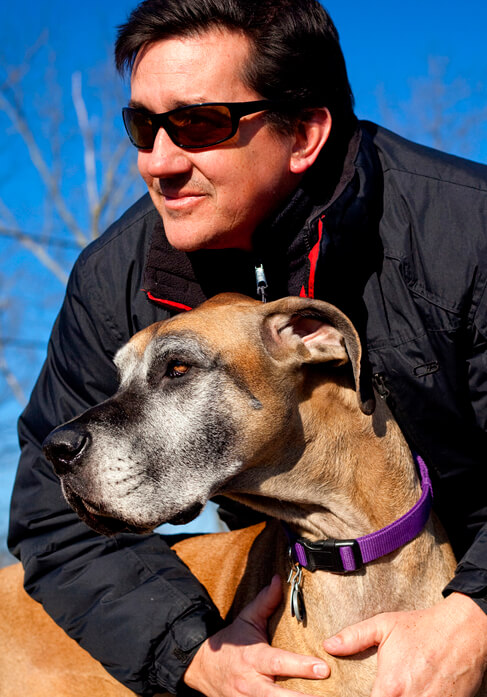
This breed is a true gentle giant. The Dane loves people and attention, is sweet and affectionate and loves to play. It is a great family dog as it adopts all members of the family and is very patient and gentle with children and smaller dogs it is raised with from puppyhood.
The dog is steady and dependable.
Because of his great size as an adult, obedience training needs to be started before he is six months old and continue through the first two years of his life. He also needs to be taught not to lean on people, especially children as he tends to lean and can easily knock someone over. A few are difficult to train, but most simply want to please their owners.
Some breeds are dog aggressive with same sex dogs.
They only bark as the occasion warrants. They are great watchdogs as they are alert and loyal as well as large and brave.
Because of their power, stamina and long legs, they can be completely out of sight almost instantly if allowed to run free.
Better suited to an indoor or outdoor lifestyle?
The real question is: do you have enough room in your house for this dog? They are not suited to be outdoors all the time. They need to be with people.
Are they suited to homes with kids?
The breeds are great family dogs who love children of all ages. They are patient and gentle with children. They need to be taught not to lean on people. They love the attention of all family members and love to play with everyone.
Great Dane Activity Level
How Active is the Breed?
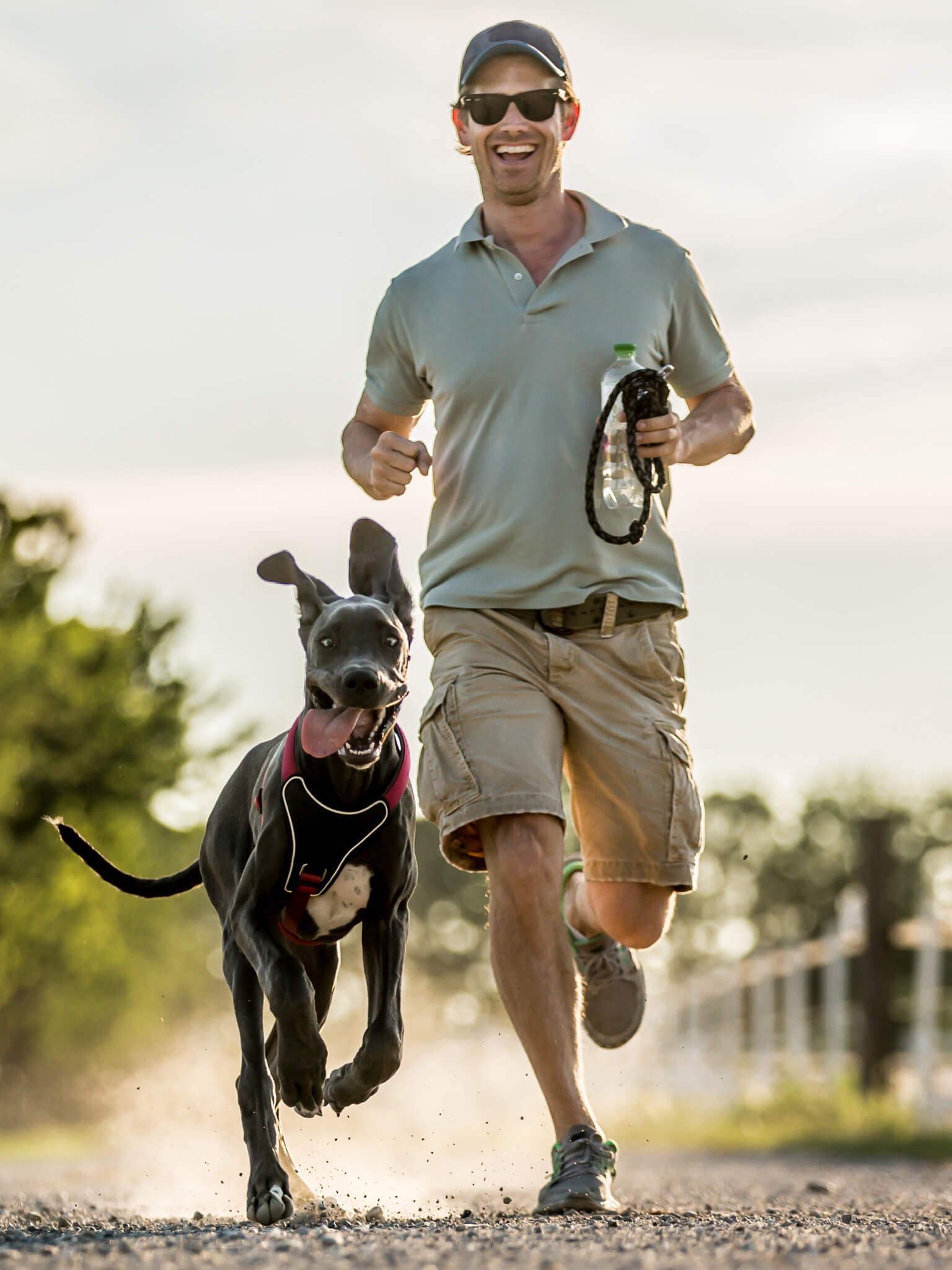
This dogs like to run. However, they are not suited to being a jogging partner until their bones and muscles are fully developed some time after their first year. They should always be kept on a lead if they are outside of a fence.
How Much Exercise Does the Dog Need at every stage of its Life?
A long daily walk or plenty of running and fetching inside a fence will suit them. As a youngster he has lots of energy. As he ages, he becomes quiet indoors and can even live in an apartment. However, he loves his outdoor times – just keep him within a tall, secure fence or on a lead.
Note: Even highly obedience-trained Danes run without listening to commands and often end up hit by a car. An injured Dane is like an injured horse and usually will have to be put down (euthanized).
Grooming
Grooming is easy with the Great Dane breed. Use a firm-bristled brush every couple of weeks. Trim nails at least monthly. Bathing is quite a chore, so use of a professional groomer if that is needed will help. This breed is an average shedder.
Free Great Dane Training Secrets
Free Course on Great Dane Training & Obedience
Stop All Bad Behavior, Excessive Barking and Biting
Health and Care
Genetic Problems
Being such a large breed, hip and elbow dysplasia are huge concerns. Make sure the parents are OFA certified. They are also prone to bloat and torsion so feed 2-3 small meals and do not allow exercise immediately after the meals. Tumors, cancers, heart disease and tail injuries are also common.
This breed has a short life span so take him to the vet for check-ups every six months instead of the normal one year.
Breeding the Dog and any Cautions
Be very aware of problems in breeding and whelping. Talk with several breeders before deciding to breed your dog.
Life Span
The larger the dog, the shorter the life span. this breeds live less than 10 years. Some have been known to make it 12-14 years.
National Breed Clubs
National Breed Clubs
British – Great Dane Breeders and Owners
Association, Great Dane Club
US – Great Dane Club of America – www.gdca.org
Other Recognition: CKC, FCI, AKC, UKC, KCGB, CKC, ANKC, NKC, NZKC, CCR, APRI, ACR
Rescue Link: www.gdca.org/rescue.htm
Group: AKC Working Group, KCGB Working Group
AKC Popularity Ranking:16
Also Known As: German Mastiff, Deutsche Dogge. The nicknames are Gentle Giant & Dane
Train Your Great Dane To Listen To You
Get Instant Access to Your Training Now - For Free
Sign up for our Free Great Dane Mini Course to have a housebroken, obedient dog that happily comes to you every time you call.
You'll learn new commands to obedience-train your dog as well as how to housebreak your dog in 6 days or less.
You'll also learn how to eliminate bad habits like barking, nipping or biting, jumping, or pulling on the leash.Here's just s small fraction of what else you'll learn in the course:
How to lead and think like a pack dog - the new psychology.
3 dangerous mistakes that most Great Dane owners make when they are trying to potty train their dogs.
The 2 main reasons why your dog barks excessively and how to control its excessive barking.
How to obedience train your Great Dane to permanently end behavioral problems like Jumping, Aggression, Pulling on Leash.
A surprisingly easy way to teach your dog cool new tricks.
How to improve your dog's lifespan and keep it from getting overly heavy with a healthy and nutritious diet.
Getting Pro help fast - how to get access to our expert trainers when you need them most.
One hidden psychological trigger that all Great Danes have... that practically allows you to "analyze" and "control" your dog's every action.
Priority access to the free online seminars conducted by our training experts.
Whereas other dog training related web sites and books offer generic information for dogs in general, ours is the ONLY web site that offers Great Dane information specifically, from a renowned panel of experts - because as you probably know, Great Danes have their own special training requirements that other dogs don't have.




What Other Dog Owners Say…

Our Free Courses
Dog Obedience TrainingDog Housetraining
Stop Dog Barking
Stop Dog Biting
HomeMade Dog food
Dog Grooming
Adopting A Dog
Read More
PureBred Dog BreedsMixed Dog Breeds
Dog Groups
Training Small Dog Breeds
Training Medium Dog Breeds
Training Large Dog Breeds
Exercising Your Dog
Dog Health
More Articles
Dog Grooming Needs
Our Tribute