Privacy Policy: Your email address is 100% safe.
We don't spam and hate it as much as you do :-) You can also unsubscribe from our mailing list at any time.

Subscribe to The FREE Flat-Coated Retriever Training Course to learn how you can easily turn your unruly and disobedient Flattie into a loving, friendly companion. Step-by-step tips for puppy housebreaking, dog obedience training and stopping bad behavior.
Sign Up
Sign Up
Flat-Coated Retriever: Key Characteristics of Flat-Coated Retriever Dog Breed
About Flat-Coated Retriever
Country of Origin, History of Flat-Coated Retrievers
The Flat-Coated Retriever is a relatively new breed. It was developed in the 1800s by crossing Irish Setters, Labrador Retrievers, Water Dogs, and the St. John’s Newfoundland. The breed was fairly popular with cod fishermen off the coast of Newfoundland and was one of several breeds referred to as “Labradors.” At some point sheepdogs – probably Collies – were added into the breeding.
The Retriever classification of the 1859 British dog show included Curly-Coated, Wavy-Coated, and Smooth-Coated Retrievers. Flat-Coats were shown as Wavy-Coated. The breed gained popularity with breeders in England. However, it was nearly lost by the end of World War II. Stanley O’Neill, a great authority on Flat-Coats, revived the breed. By the mid-1960s it was flourishing in the United States as well as Europe.
It is a very highly regulated breed by those who raise Flat-Coats. Those desiring to own them must sign contracts with very strict rules on breeding and not relinquishing a dog and must be tightly screened for appropriateness of placement of each puppy.
Flat-Coated Retriever Tools
Breed Selector Tool - is the Flat-Coated Retriever the right breed for you?
Is the Flat-Coated Retriever the right breed for you and your family?
Find out by using our Free Dog Breed Selector Tool
Check Your Flat-Coated Retriever's Learning Style
Are you aware dogs also have a learning style that can greatly affect their ability to housetrain as well as be trained correctly. Evaluate your Flat-Coated Retriever's learning style and personality using our free Learning Style tool so that you are better able to provide him with the proper Flat-Coated Retriever training methods.
Is your Flat-Coated Retriever dominating over you?
Does your Flat-Coated Retriever bark unnecessarily? Does your Flat-Coated Retriever come to you when you call? Download a FREE Report on Dog Dominance for you and your Flat-Coated Retriever and learn how to control your dog.
Do you make these mistakes with your Flat-Coated Retriever?
Are you inadvertently snow-balling bad behavior in your Flat-Coated Retriever? Evaluate your Dog Training Style from our Free Tool and learn how best to deal with your dog.
Flat-Coated Retriever Calorie Calculator
Do you know how many calories your Flat-Coated Retriever needs every day and how many cups of food you should be giving it every day? Click here to use our Flat-Coated Retriever Calorie Calculator.
A General Appearance of the Dog
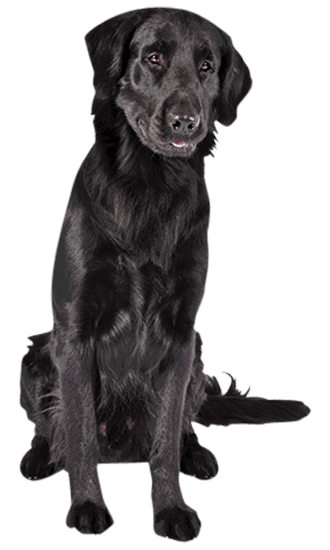
The silhouette of a Flat-Coated Retriever is unforgettable. Often described as a cross between a Golden Retriever and an Irish Setter, the Flat Coat is lean, sleek, and powerful. The Flat-Coated Retriever’s back is level and his head and neck appear to be a single part. His head is narrower than a Golden’s.
A Flat-Coat is well-balanced and extremely elegant. Although his legs appear small in diameter, they are very strong and springy. Flat-Coated Retrievers look proud and intelligent and act alert, happy and ready to go. The medium length black or brown coat is extremely shiny and lies flat against the body. The legs and tail are well feathered.
Coat Color
The Flat-coated Retriever comes in two colors – black or liver. Both colors are solid and cannot have even one hair of any other color. The coat is very shiny and lies flat against the body.
Coat Type
The medium length black or brown coat is extremely shiny and lies flat against the body. There is also an undercoat which becomes much heavier in the fall and winter. The legs and tail are well feathered.
Flat-Coated Retrievers are constant shedders with extremely heavy shedding in the spring and fall. Using a shedding blade on them is often necessary during their heavy shedding times. Your house will always have black or brown fur floating around and on the floors.
Height
Males: 23 – 24.5 inches
Females: 22 – 23.5 inches
The English version of the Flat-Coated Retriever tends to be taller than the American version.
Weight
60-70 lbs for both male and female is appropriate.
This breed should look lean and muscular. The ribs should be able to be seen. Do not overfeed.

Free Flat-Coated Retriever Training Secrets
Free Course on Flat-Coated Retriever Training & Obedience
Stop All Bad Behavior, Excessive Barking and Biting
Flat-Coated Retriever Personality Traits

Temperament of the Dog
Flat-Coated Retrievers are very active dogs. They are smart and friendly and learn quickly, but sometimes they can be too friendly. Regular, consistent obedience training can help prevent this problem.
Flat-Coats are always cheerful and ready for a game, a run, or a ride in the car. Their puppy-like exuberance lasts well into later years.
Flat-Coated Retrievers seldom bark except to ask to go play with someone, so do not get them to be a watchdog. They are known to be 'counter cruisers' – stealers of food left on the kitchen counter!
Better suited to an indoor or outdoor lifestyle?
Flat-Coated Retrievers are very excitable dogs when outdoors and love to swim, hunt, and retrieve. They are very soft-mouthed and are great retrievers of waterfowl.
However, when they get indoors, they quiet down and are very sociable, although they demand quite a bit of human contact and attention. Flat-Coats always want their heads rubbed, backs scratched or someone with which to curl up and sleep.
Are they suited to homes with kids?
The Flat-Coated Retriever is superb with children. The more people in the family (even if they are only there sometimes) the happier he is! As a family dog, he has a gentle, even temperament. He is smart, active, and friendly with everyone. The Flat-Coat never snaps and seldom growls, usually moving to allow another pet to eat his food rather than fight for it.
Training
Training Your Flattie
Flattie training and socialization should start early and be consistent throughout their life, or they will not be consistent in obeying. They need plenty of short training sessions and training games because they are easily bored and distracted. They do best when their training is mixed up some, with games and other things mixed in with training.
They make excellent obedience and agility dogs. They are also very good at flyball and hunting trials. They make excellent companions for those who jog or run or camp and hike.
Free Flat-Coated Retriever Training Secrets
Free Course on Flat-Coated Retriever Training & Obedience
Stop All Bad Behavior, Excessive Barking and Biting
Flat-Coated Retriever Activity Level
How active is the Breed?
Flat-Coated Retrievers are one of the most active breeds. They remain very active throughout their lives.
Exercise Need
Flat-Coats need to run and play every day. They like a large, fenced yard with activities outside the yard to watch. A farm or ranch suits them fine, especially if there is a creek to play in and other animals to run with. However, they will settle down indoors.
Adult Flat-Coats can live in an apartment if they have a couple of long, brisk walks a day and a romp in a dog park or safely fenced area several times a week. Always keep them on a leash as they will run to see other people and animals with no regard for traffic no matter how well obedience-trained they are and the consequences will be tragic.
Grooming
A weekly brushing is necessary to keep the Flat-Coats beautiful coat free of debris. Daily brushing will help with the amount of shedding. During the spring and fall, it may be necessary to use a shedding blade on the Flat Coat on an almost daily basis to help him get rid of his coat.
The monthly trimming of the toenails can be a real problem with this breed as his feet and legs are very sensitive and ticklish. Handle his feet often when he is young and always use a firm (not harsh) touch.
Flat-Coated Retrievers are prone to “Retriever Ear” and ear infections. Clean the ears at least once a week.
Free Flat-Coated Retriever Training Secrets
Free Course on Flat-Coated Retriever Training & Obedience
Stop All Bad Behavior, Excessive Barking and Biting
Health and Care
Genetic Problems
Health problems of the Flat-Coated Retriever include cancer, luxated patella (displaced kneecap), eyelash problems, cataracts, Ectropian, Entropian, glaucoma, hip dysplasia, PRA, CHD, diabetes, and epilepsy.
Breeding the Dog and any Cautions
Many litters in this breed have at least one puppy that is born with problems that need extensive medical care. Spend time with breeders who have had several litters to understand the extent of the care that is needed for whelping and raising a litter.
Litter Size: Litters can be as large as 13 puppies, but most litters are 6-10.
Life Span: About 10 – 12 years.
National Breed Clubs
National Breed Clubs
British – FlatCoated Retriever
Society - www.flatcoated-retriever-society.org
US – Flat-Coated Retriever Society of America,
Inc. – www.fcrsainc.org
Other Recognition: CKC, FCI, AKC, UKC, KCGB, ANKC, NKC, NZKC, CCR, APRI, ACR
Rescue Link: www.fcrsainc.org/rescue/index.html
Group: Sporting Group
AKC Popularity Ranking: 91
Also Known As: Flattie, Flat-coats
Train Your Flat-Coated Retriever To Listen To You
Get Instant Access to Your Training Now - For Free
Sign up for our Free Flat-Coated Retriever Mini Course to have a housebroken, obedient dog that happily comes to you every time you call.
You'll learn new commands to obedience-train your dog as well as how to housebreak your dog in 6 days or less.
You'll also learn how to eliminate bad habits like barking, nipping or biting, jumping, or pulling on the leash.Here's just s small fraction of what else you'll learn in the course:
How to lead and think like a pack dog - the new psychology.
3 dangerous mistakes that most Flattie owners make when they are trying to potty train their dogs.
The 2 main reasons why your dog barks excessively and how to control its excessive barking.
How to obedience train your Flat-Coated Retriever to permanently end behavioral problems like Jumping, Aggression, Pulling on Leash.
A surprisingly easy way to teach your dog cool new tricks.
How to improve your dog's lifespan and keep it from getting overly heavy with a healthy and nutritious diet.
Getting Pro help fast - how to get access to our expert trainers when you need them most.
One hidden psychological trigger that all Flat-Coated Retrievers have... that practically allows you to "analyze" and "control" your dog's every action.
Priority access to the free online seminars conducted by our training experts.
Whereas other dog training related web sites and books offer generic information for dogs in general, ours is the ONLY web site that offers Flattie information specifically, from a renowned panel of experts - because as you probably know, Flatties have their own special training requirements that other dogs don't have.




What Other Dog Owners Say…

Our Free Courses
Dog Obedience TrainingDog Housetraining
Stop Dog Barking
Stop Dog Biting
HomeMade Dog food
Dog Grooming
Adopting A Dog
Read More
PureBred Dog BreedsMixed Dog Breeds
Dog Groups
Training Small Dog Breeds
Training Medium Dog Breeds
Training Large Dog Breeds
Exercising Your Dog
Dog Health
More Articles
Dog Grooming Needs
Our Tribute