Privacy Policy: Your email address is 100% safe.
We don't spam and hate it as much as you do :-) You can also unsubscribe from our mailing list at any time.
Subscribe to The FREE Doberman Pinscher Training Course to learn how you can easily turn your unruly and disobedient Doberman into a loving, friendly companion. Step-by-step tips for puppy housebreaking, dog obedience training and stopping bad behavior.
Sign Up
Sign Up
Doberman Pinscher: Training, Temperament, Health (Doberman, Dob)
About Doberman Pinscher
Country of Origin, History of Doberman Pinschers
The Doberman traces its roots to 19th Century Germany, where it was developed as a police dog by Herr Louis Dobermann- a policeman and tax collector. The man required a loyal, obedient and fiercely protective dog to accompany him on his nightly rounds. Since he also worked as the keeper of the local animal shelter, he had a continuous supply of breeding stock to help him develop just such an animal.
Some of the breeds used to shape the Dobe include the German Pinscher, Rottweiler and German Shorthaired Pointer. The resulting dog possessed an uncanny intelligence, bravery, loyalty, stamina, and protectiveness, and was easy to care for. It was with great pride that this breed became known as "Dobermann's Pinscher."
After Dobermann died in 1894, his protégé, Otto Goeller, continued his mentor's plans and is credited by many as the true architect of the breed. Goeller organized the National Dobermann Pinscher Club in Germany in 1899. Shortly thereafter he and his committee members wrote the first breed standard.
By 1890, the Doberman was born and by 1900 the breed was officially recognized. Soon the breed was imported to the United States. By 1921, the Doberman Pinscher Club of America was founded and the dog quickly gained popularity as a working breed.
Today's Doberman Pinscher has lost the second 'n' from its name and has mellowed in fierceness to become a family member capable of displaying great gentleness and devotion to children and other animals in the home. Having left behind his terrier roots, he has also dropped the Pinscher portion of the name in many countries.
Doberman Pinscher Tools
Breed Selector Tool - is the Doberman Pinscher the right breed for you?
Is the Doberman Pinscher the right breed for you and your family?
Find out by using our Free Dog Breed Selector Tool
Check Your Doberman Pinscher's Learning Style
Are you aware dogs also have a learning style that can greatly affect their ability to housetrain as well as be trained correctly. Evaluate your Doberman Pinscher's learning style and personality using our free Learning Style tool so that you are better able to provide him with the proper Doberman Pinscher training methods.
Is your Doberman Pinscher dominating over you?
Does your Doberman Pinscher bark unnecessarily? Does your Doberman Pinscher come to you when you call? Download a FREE Report on Dog Dominance for you and your Doberman Pinscher and learn how to control your dog.
Do you make these mistakes with your Doberman Pinscher?
Are you inadvertently snow-balling bad behavior in your Doberman Pinscher? Evaluate your Dog Training Style from our Free Tool and learn how best to deal with your dog.
Doberman Pinscher Calorie Calculator
Do you know how many calories your Doberman Pinscher needs every day and how many cups of food you should be giving it every day? Click here to use our Doberman Pinscher Calorie Calculator.
Description of the Dog
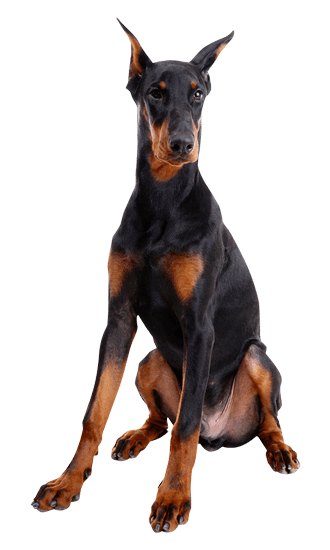
The Doberman is a very muscular and powerful dog and has many elegant features. The dog is well proportioned, compact, has a muscular neck, lean body, and an unmistakeable air of aristocracy, nobility and elegance.
The ideal Doberman head is wedge-shaped with eyes blending in with the color of the coat. Dark eyes are much preferred over other shades and should be relatively deep set. A Doberman's expression should display his great intelligence and vigorous character.
The dog’s ears may be cropped, though cropping is illegal in many countries including Great Britain and Australia but many others, including American Doberman fanciers, believe that an erect, cropped ear enhances the appearance of this breed. The dog’s tail is usually docked at birth at approximately the second joint of the spine.
Coat
The short, gleaming coat is typically black with rust markings or red with lighter rust markings. Less common, but also acceptable in the breed, are blue and fawn (Isabella) with lighter markings.
The rust markings should appear on the muzzle, the throat, above the eyes, the front of the chest, beneath the tail and on all legs and feet. A small white patch less than one-half inch square is permissible on the chest but no other white is allowed. White Dobermans may not be shown, as this is a disqualifying fault.
Height
Male: 26 and 28 inches at the
shoulder
Female: 24 to 26 inches at the shoulder.
Weight
The weight of an adult dog will typically range between 60 and 85 pounds depending on size and sex.

Free Doberman Pinscher Training Secrets
Free Course on Doberman Pinscher Training & Obedience
Stop All Bad Behavior, Excessive Barking and Biting
Doberman Pinscher Personality Traits
Temperament of the Dog
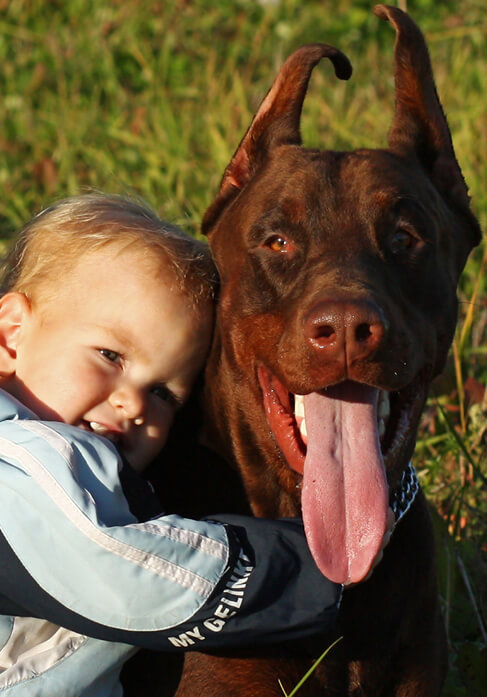
Originally bred to be a fierce dog, the Doberman Pinscher's temperament has has toned down over the years and the dog is now a loving and devoted family pet. The breed is known to be bold, alert and loyal with a strong desire to please.
Its innate guarding instinct makes it a good watchdog. Despite being loyal and protective, if improperly bred or raised, the breed can be mean or aggressive.
The Doberman is intelligent and can be domineering and it is not unusual for this breed to produce one-man and one-family dogs because of their great loyalty.
The Doberman must have constant human companionship and social interaction, not only with its owner but also with all kinds of people and other dogs. This is essential to the well being of the breed.
Better suited to an indoor or outdoor lifestyle?
The dog enjoys both an indoor and outdoor lifestyle, and does not like to be abandoned in the backyard or away from its family. The Doberman is very sensitive to cold as they have very thin hair and should not be left outside in the cold or overnight. As long as the dog is well exercised, it can adapt well to living in a flat.
Dobes are large dogs with great intelligence and a high prey drive, which can make them a formidable breed for the first time dog owner.
Are they suited to homes with kids?
A well-socialised Dobermann is
capable of displaying gentleness and devotion to
children and other animals in the home. Both puppy
and children should be taught to respect each other
from the start. Despite being loyal and protective,
if improperly bred or raised, the breed can be mean
or aggressive and is not a good choice for first
time owners or families with toddlers who could
get hurt by the dog's bulk.
They can be very good with other dogs, especially
if they all are of good temperament. Aggression
towards other dogs is accepted in the AKC breed
standard.
Training
Highly intelligent, these dogs are quick to learn and enjoy mental stimulation. An energetic and versatile breed, the dog excels in canine sports from obedience to agility. This breed is full of quick learners and training should be undertaken as soon as possible to control its assertive nature. The Doberman can display undesirable behaviours if it is deprived of exercise and training.
Doberman owners must accept from the beginning that Dobermans can be mischievous - they can cause damage to your house and garden, and they can be noisy. If you are particularly house-proud and can't bear the thought of a dog making a mess, then this breed is not for you.
A well-trained and obedient Doberman is, nevertheless, a joy to watch, and the breed is used by police forces in various countries.
Free Doberman Pinscher Training Secrets
Free Course on Doberman Pinscher Training & Obedience
Stop All Bad Behavior, Excessive Barking and Biting
Doberman Pinscher Activity Level
Exercise Needs
Exercise is critical for to health and well being of the dogs. They were bred and born to work and have a great deal of energy to burn. Most Dobermans require about an hour of exercise a day to keep fit. Long walks and frequent play sessions in secure areas will make your dog fit and keep him from becoming nervous. Other exercise alternatives can include playing fetch, swimming or hurdle jumping. The Doberman that is given plenty of opportunity to exercise is a much happier and healthier dog.
How to take care of a Doberman Puppy?
A well-socialised Dobermann is capable of displaying gentleness and devotion to children and other animals in the home. Both puppy and children should be taught to respect each other from the start.
Despite being loyal and protective, if improperly bred or raised, the breed can be mean or aggressive and is not a good choice for first time owners or families with toddlers who could get hurt by the dog’s bulk.
They can be very good with other dogs, especially if they all are of good temperament. Aggression towards other dogs is accepted in the AKC breed standard.
Health and Care
Genetic Problems
Overall, the breed is healthy but can be prone to a few disorders including, Von Willebrand's disease (a bleeding disorder), Wobbler syndrome (disease of the spinal column), gastric torsion (a life-threatening sudden illness associated with the stomach filling with air and twisting), skin diseases, hip dysplasia and dilated cardiomyopathy.
Litter Size: 3 to 5 pups.
Life Span: 10 to 12 years.
Free Doberman Pinscher Training Secrets
Free Course on Doberman Pinscher Training & Obedience
Stop All Bad Behavior, Excessive Barking and Biting
National Breed Clubs
Breeder Club: Doberman Pinscher Club of America, Doberman Pinscher Alliance of America
Recognition: CKC, FCI, AKC, UKC, KCGB, CKC, ANKC, NKC, NZKC, CCR, APRI, ACR
Group:Working Group.
AKC Popularity Ranking:17.
Also Known As: Dobie, Dobe.
Train Your Doberman Pinscher To Listen To You
Get Instant Access to Your Training Now - For Free
Sign up for our Free Doberman Pinscher Mini Course to have a housebroken, obedient dog that happily comes to you every time you call.
You'll learn new commands to obedience-train your dog as well as how to housebreak your dog in 6 days or less.
You'll also learn how to eliminate bad habits like barking, nipping or biting, jumping, or pulling on the leash.Here's just s small fraction of what else you'll learn in the course:
How to lead and think like a pack dog - the new psychology.
3 dangerous mistakes that most Doberman owners make when they are trying to potty train their dogs.
The 2 main reasons why your dog barks excessively and how to control its excessive barking.
How to obedience train your Doberman Pinscher to permanently end behavioral problems like Jumping, Aggression, Pulling on Leash.
A surprisingly easy way to teach your dog cool new tricks.
How to improve your dog's lifespan and keep it from getting overly heavy with a healthy and nutritious diet.
Getting Pro help fast - how to get access to our expert trainers when you need them most.
One hidden psychological trigger that all Doberman Pinschers have... that practically allows you to "analyze" and "control" your dog's every action.
Priority access to the free online seminars conducted by our training experts.
Whereas other dog training related web sites and books offer generic information for dogs in general, ours is the ONLY web site that offers Doberman information specifically, from a renowned panel of experts - because as you probably know, Dobermans have their own special training requirements that other dogs don't have.




What Other Dog Owners Say…

Our Free Courses
Dog Obedience TrainingDog Housetraining
Stop Dog Barking
Stop Dog Biting
HomeMade Dog food
Dog Grooming
Adopting A Dog
Read More
PureBred Dog BreedsMixed Dog Breeds
Dog Groups
Training Small Dog Breeds
Training Medium Dog Breeds
Training Large Dog Breeds
Exercising Your Dog
Dog Health
More Articles
Dog Grooming Needs
Our Tribute