Privacy Policy: Your email address is 100% safe.
We don't spam and hate it as much as you do :-) You can also unsubscribe from our mailing list at any time.
Subscribe to The FREE Bull Mastiff Training Course to learn how you can easily turn your unruly and disobedient Bull Mastiff into a loving, friendly companion. Step-by-step tips for puppy housebreaking, dog obedience training and stopping bad behavior.
Sign Up
Sign Up
Bullmastiff: Personality, Exercise, Health
About Bull Mastiff
Country of Origin, History of Bull Mastiffs
The Bullmastiff was developed in England by gamekeepers (on game preserves and large estates) for protection against poachers. They needed a fearless dog that would attack on command. He is 60% Mastiff and 40% Bulldog. The dark, brindle was preferred and referred to as the ‘Night Dog.’
Bull Mastiff Tools
Breed Selector Tool - is the Bull Mastiff the right breed for you?
Is the Bull Mastiff the right breed for you and your family?
Find out by using our Free Dog Breed Selector Tool
Check Your Bull Mastiff's Learning Style
Are you aware dogs also have a learning style that can greatly affect their ability to housetrain as well as be trained correctly. Evaluate your Bull Mastiff's learning style and personality using our free Learning Style tool so that you are better able to provide him with the proper Bull Mastiff training methods.
Is your Bull Mastiff dominating over you?
Does your Bull Mastiff bark unnecessarily? Does your Bull Mastiff come to you when you call? Download a FREE Report on Dog Dominance for you and your Bull Mastiff and learn how to control your dog.
Do you make these mistakes with your Bull Mastiff?
Are you inadvertently snow-balling bad behavior in your Bull Mastiff? Evaluate your Dog Training Style from our Free Tool and learn how best to deal with your dog.
Bull Mastiff Calorie Calculator
Do you know how many calories your Bull Mastiff needs every day and how many cups of food you should be giving it every day? Click here to use our Bull Mastiff Calorie Calculator.
A General Appearance of the Dog
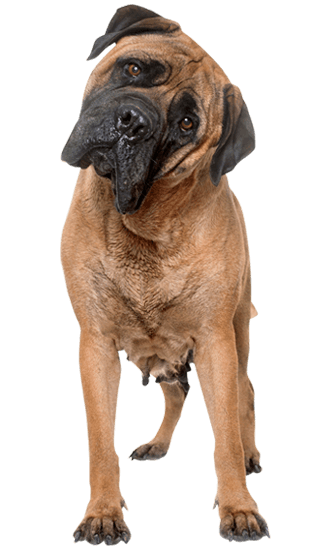
The Bullmastiff is a powerfully built dog. He has a broad, wrinkled head with a short, square muzzle. He also has a wrinkled neck. His ears are V-shaped and set wide and high on his head and his nose, jowls and ears are black.
The Bullmastiff’s back is short and level. He has a tapering tail set high.
The Bullmastiff should appear strong and alert.
Coat Color
Bullmastiffs come in fawn, brindle, or red with black markings on the head – the muzzle, around the eyes, and the ears are dark. The color fades out into ivory or white going down the legs and onto the stomach.
Coat Type
The Bullmastiff has a short coat with little shedding.
Height
Males: 25 -27 inches
Females: 24 – 26 inches
Weight
Males: 110 – 133 lbs
Females: 100 – 120 lbs

Free Bull Mastiff Training Secrets
Free Course on Bull Mastiff Training & Obedience
Stop All Bad Behavior, Excessive Barking and Biting
Bull Mastiff Personality Traits
Temperament of the Dog
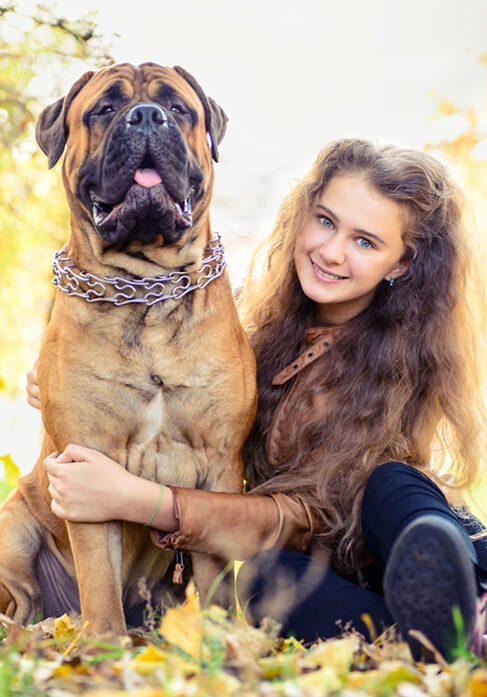
The Bullmastiff appears calm but is fearless and confident. He is reliable and intelligent. He wants to please his master, so he is trainable and makes a good companion.
The Bullmastiff can be good-natured
but tends to be willful. He is an extremely powerful
dog, so early training is critical. A firm and consistent
master is a great help.
They should be obedience trained and taught not
to pull on the leash. Bullmastiffs are sensitive
to the tone of voice being used. Socialization with
people and animals is crucial. Bullmastiffs can
be aggressive toward other dogs. They are reserved
with strangers.
His method of attack is to knock down an intruder and hold him on the ground. Unfortunately, because of his size, he can accidently knock down a child or an adult when he is playing.
Bullmastiffs crave human attention.Bullmastiff puppies are uncoordinated. They drool, slobber, and snore.
Better suited to an indoor or outdoor lifestyle?
Bullmastiffs should never be left to a kennel outdoors. They need human interaction and training.
Are they suited to homes with kids?
He is tolerant of children, especially if he has known them all his life. He needs to be thoroughly socialized with children and their friends. Because of his size and power, he can accidently knock down a child while playing.
Bull Mastiff Activity Level
How Active is the Breed?
Bullmastiffs tend to be lazy and will not expend any more energy than absolutely necessary. Therefore, they need to be taken on daily long walks and encouraged to exercise. Otherwise, they will put on weight.
They cannot tolerate extremes of temperature.
They are fairly inactive indoors, so they can live in an apartment setting.
How Much Exercise Does the Dog Need at every stage of its Life?
A small fenced yard for playing and walks will suit the needs of a young Bullmastiff. As he gets older, he will have to be encouraged to take walks and to play.
Grooming
The short, rough coat of the Bullmastiff needs some brushing, but seldom needs bathing. Because the dog carries a lot of weight, check his feet often and keep the nails short.
Free Bull Mastiff Training Secrets
Free Course on Bull Mastiff Training & Obedience
Stop All Bad Behavior, Excessive Barking and Biting
Health and Care
Genetic Problems
Bullmastiffs are prone to cancer, hip dysplasia, tumors, and PRA and eyelid problems.
Bullmastiffs get boils on their lips.
To avoid Bloat, feed them 2-3 small meals a day. Do not overfeed Bullmastiffs as they tend to put on more weight than they need.
Litter Size: 4 – 13 puppies with an average litter size of 8.
Life Span: Larger, heavier dogs have shorter life spans than smaller or leaner dogs. Most Bullmastiffs live less than 10 years.
National Breed Clubs
National Breed Clubs
British – Bullmastiff Association
– www.Bullmastiffassociation.co.uk
British Bullmastiff League
US – American Bullmastiff Association, Inc.
– http://clubs.akc.org/aba/index.html
Other Recognition: CKC, FCI, AKC, KCGB, CKC, ANKC, NKC, NZKC, APRI, ACR
Rescue Link: www.gdca.org/rescue.htm
Group: Working Group
AKC Popularity Ranking: 51
Train Your Bull Mastiff To Listen To You
Get Instant Access to Your Training Now - For Free
Sign up for our Free Bull Mastiff Mini Course to have a housebroken, obedient dog that happily comes to you every time you call.
You'll learn new commands to obedience-train your dog as well as how to housebreak your dog in 6 days or less.
You'll also learn how to eliminate bad habits like barking, nipping or biting, jumping, or pulling on the leash.Here's just s small fraction of what else you'll learn in the course:
How to lead and think like a pack dog - the new psychology.
3 dangerous mistakes that most Bull Mastiff owners make when they are trying to potty train their dogs.
The 2 main reasons why your dog barks excessively and how to control its excessive barking.
How to obedience train your Bull Mastiff to permanently end behavioral problems like Jumping, Aggression, Pulling on Leash.
A surprisingly easy way to teach your dog cool new tricks.
How to improve your dog's lifespan and keep it from getting overly heavy with a healthy and nutritious diet.
Getting Pro help fast - how to get access to our expert trainers when you need them most.
One hidden psychological trigger that all Bull Mastiffs have... that practically allows you to "analyze" and "control" your dog's every action.
Priority access to the free online seminars conducted by our training experts.
Whereas other dog training related web sites and books offer generic information for dogs in general, ours is the ONLY web site that offers Bull Mastiff information specifically, from a renowned panel of experts - because as you probably know, Bull Mastiffs have their own special training requirements that other dogs don't have.




What Other Dog Owners Say…

Our Free Courses
Dog Obedience TrainingDog Housetraining
Stop Dog Barking
Stop Dog Biting
HomeMade Dog food
Dog Grooming
Adopting A Dog
Read More
PureBred Dog BreedsMixed Dog Breeds
Dog Groups
Training Small Dog Breeds
Training Medium Dog Breeds
Training Large Dog Breeds
Exercising Your Dog
Dog Health
More Articles
Dog Grooming Needs
Our Tribute