Privacy Policy: Your email address is 100% safe.
We don't spam and hate it as much as you do :-) You can also unsubscribe from our mailing list at any time.
Subscribe to The FREE Brussels Griffon Training Course to learn how you can easily turn your unruly and disobedient Griffon into a loving, friendly companion. Step-by-step tips for puppy housebreaking, dog obedience training and stopping bad behavior.
Sign Up
Sign Up
Brussels Griffon: Personality, Health, Grooming
About Brussels Griffon
Country of Origin, History of Brussels Griffons
The Brussels Griffon breed originated in Belgium. Once kept by cab drivers (coachmen) of 17th-century Brussels to rid their stables of vermin (rats), the Brussels Griffon became a companion breed by virtue of its appealing character.
The Smooth-coated Petit Brabancon probably owes its existence to the introduction of pug blood. It is reasonably well documented that the Pug and the King Charles and the Ruby Spaniels were crossed with the original Belgian dog. From these crossings, two distinct types of coat emerge, the harsh-coated, bewhiskered rough, and the smooth-coated Brabancon.
Some of the colorings also are attributed to these crosses: rich red, black and tan, and solid black. The Brussels Griffon was imported to England and America during the 1880s.
Brussels Griffon Tools
Breed Selector Tool - is the Brussels Griffon the right breed for you?
Is the Brussels Griffon the right breed for you and your family?
Find out by using our Free Dog Breed Selector Tool
Check Your Brussels Griffon's Learning Style
Are you aware dogs also have a learning style that can greatly affect their ability to housetrain as well as be trained correctly. Evaluate your Brussels Griffon's learning style and personality using our free Learning Style tool so that you are better able to provide him with the proper Brussels Griffon training methods.
Is your Brussels Griffon dominating over you?
Does your Brussels Griffon bark unnecessarily? Does your Brussels Griffon come to you when you call? Download a FREE Report on Dog Dominance for you and your Brussels Griffon and learn how to control your dog.
Do you make these mistakes with your Brussels Griffon?
Are you inadvertently snow-balling bad behavior in your Brussels Griffon? Evaluate your Dog Training Style from our Free Tool and learn how best to deal with your dog.
Brussels Griffon Calorie Calculator
Do you know how many calories your Brussels Griffon needs every day and how many cups of food you should be giving it every day? Click here to use our Brussels Griffon Calorie Calculator.
A General Appearance of the Dog
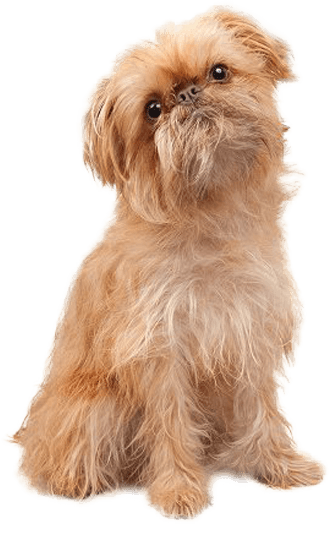
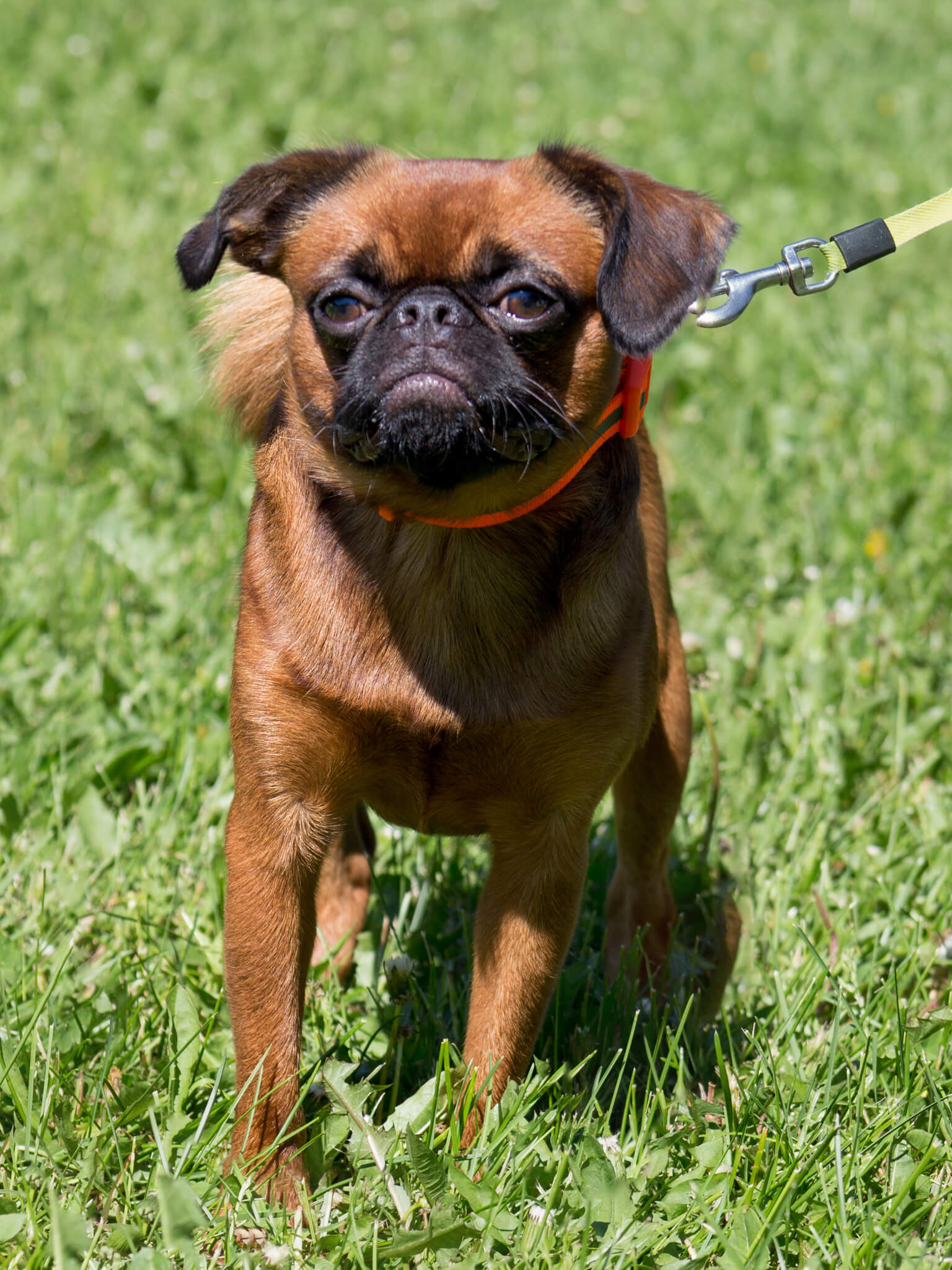
The Brussels Griffon is a sturdy, compact little dog of squarish proportions. His thickset body is agile and sporty and serves to offset his most pronounced feature, a large domed head. The expressive nature of this breed’s face is his most noted characteristic.
The breed is sometimes known as the “Monkey Faced” dog due to its unique, almost human pout. His eyes are prominent and set well apart with long lashes and dark edges. His nose is usually very black and short. It is set back towards the eyes and up-tipped. The ears are small and set high on the head and can be cropped which will give them a pointed look or left natural giving them a soft fold forward. The jaw is undershot, and along with a natural beard, gives him a human-like expression.
Coat Color
There are four basic coat colors:
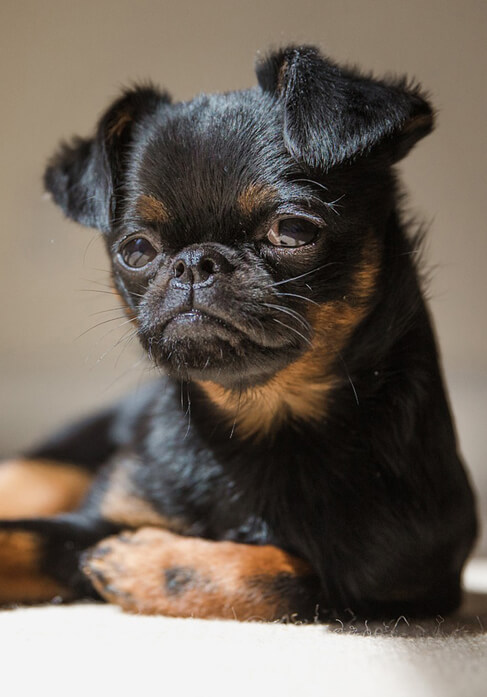
1) Red: reddish brown with a little
black at the whiskers and chin;
2) Belge: black and reddish brown mixed, usually
with black mask and whiskers;
3) Black and Tan: black with uniform reddish brown
markings, appearing under the chin, on the legs,
above each eye, around the edges of the ears and
around the vent;
4) Black: solid black.
Coat Type
The Brussels Griffon coat comes in two types, rough or smooth. The coat, whether rough or smooth, should be brushed and trimmed to maintain a neat appearance while the wired type should never appear unkempt or over-groomed.
Rough: The rough coat tends to be dense with a ‘wiry’ texture but neither woolly nor silky. It can be 1-2 inches in length on the body and slightly longer around the eyes, cheeks and chin, forming a fringe around the face.
Smooth: The smooth coat has short, straight hair that is glossy in appearance.
Height: Males and Females: 7-8 inches
Weight: 6 – 12 Lbs; ideally 8 – 10 lbs

Free Brussels Griffon Training Secrets
Free Course on Brussels Griffon Training & Obedience
Stop All Bad Behavior, Excessive Barking and Biting
Brussels Griffon Personality Traits
Temperament of the Dog
The Brussels Griffon is a very-intelligent lively and entertaining breed. Their terrier like disposition can make them high strung and demanding, but a willingness to please will help to temper these characteristics. They are thought of as even-tempered and congenial with a loyal nature. Their need for companionship and attention can make them a great pet for singles as well as families. This breed loves to be spoiled.
The Brussels Griffon can be self-conscious around strangers and appear withdrawn but early socialization will help to avoid this.
Patience is required with the Brussels Griffon, as this breed is sometimes difficult to housebreak. Puppies are known to relieve themselves quickly and quietly around the home. As a result, the Brussels Griffon needs to receive consistent crate training early. The crate serves not only as a safe place for your pet but also helps in avoiding mischievous behavior when your Brussels Griffon becomes bored.
The Griffon is good with other dogs and even with cats. The breed can be vocal, making them a fine watchdog but early training should teach the difference between alerting you to strangers and just wanting to be noticed.
Better suited to an indoor or outdoor lifestyle?
Griffons are good dogs for apartment life and will do okay without a yard, but they will require much indoor play in addition to regular daily walks. They can be very social on lead and should be allowed to express this on a regular basis.
Are they suited to homes with kids?
Breeders of the Brussels Griffon recommend placement in a families with older children who are considerate of the small dog's stature and are not teasing in nature.
Training
Patience is required with the Brussels Griffon, as this breed is difficult to housebreak. Puppies are known to relieve themselves quickly and quietly around the home. As a result, the Brussels Griffon needs to receive consistent crate training. The actual training should be easy for the pup to comprehend, and the activities need to be consistent and precise. The Brussels Griffon learns quickly, but its ability to obey commands tends to be below average. Training also needs to be firm to prevent the Brussels Griffon from becoming demanding or manipulative towards the trainer.
Free Brussels Griffon Training Secrets
Free Course on Brussels Griffon Training & Obedience
Stop All Bad Behavior, Excessive Barking and Biting
Brussels Griffon Activity Level
The activity level of the Brussels Griffon is high, and these dogs need to have outdoor exercise on a regular basis. This breed enjoys walking and has highly developed climbing skills. Care should be taken to closely supervise any climbing activity; the Brussels Griffon may fall and sustain severe injuries if it falls from several feet off the ground.
How Much Exercise Does the Dog Need at every stage of its Life?
Puppies of the Brussels Griffon are very active and need lots of toy play to keep them both physically and mentally exercised. Early training will serve to enlighten and occupy your pet. Without proper outlets for energy, this breed can become mischievous and destructive. Giving your Brussels Griffon the right direction in the beginning will not only allow entertainment for you and your family but give him an enjoyable start.
Adult Brussels Griffon are still quite active but need less toy play and are happy with walks or time spent in the yard.
How to take care of a Griffon Puppy?
How to take care of the Puppy?
Puppies of this breed need to be consistently supervised as they can easily become lost or harmed within an indoor or outdoor environment. An early trip to the veterinarian for a general checkup is recommended, especially if the Brussels Griffon pup was purchased from a private party.
Litter Size: 1-3 Puppies
Life Span: 8-10 Years
Grooming
The Brussels Griffon needs to be brushed two to three times a week.
This breed’s rough coat requires hand stripping by a professional groomer and the financial considerations of this service should be taken into account when choosing this coat type. The dog’s facial hair should be combed frequently to remove debris and food remnants. Owners can use a grooming mitt to remove dead hair from the dog’s body.
The smooth coated types of the breed are easily maintained and usually can be done at home by their owners.
Bathing for either type of coat should only be when necessary. The Brussels Griffon’s nails need to be clipped once or twice a month.
This breed sheds little to no hair and is quite clean and odor free.
Free Brussels Griffon Training Secrets
Free Course on Brussels Griffon Training & Obedience
Stop All Bad Behavior, Excessive Barking and Biting
Health and Care
Due to its small size, the Brussels Griffon must receive consistent supervision. In addition, an owner must be aware of the dog's environment, both inside and outside of the home. A large breed of dog can easily kill a Brussels Griffon by vigorously shaking the small dog. The Brussels Griffon breed should always remain in the house or in a secured yard.
Genetic Problems
The Brussels Griffon can develop trachea problems which can result in pulmonary hypertension and congestive heart failure. Another problem with this breed is potential facial anatomy abnormalities. The dog may have a soft palate which results in breathing difficulty. Also, narrowing of the nostrils may develop. A physical exam can detect these problems, and they can be corrected with surgery. Proper breeding will help to reduce the degree of any of these problems.
Breeding the Dog and any Cautions
The Brussels Griffon has difficulty becoming pregnant and will also have difficulty delivering its puppies. A Caesarian Section is often required in this breed.
Unfortunately, approximately only 60 percent of the puppies in a litter will survive.
Consultation with your breeder is most important if you are considering this breed, especially if you want to do breeding.
National Breed Clubs
National Breed Clubs
British – Griffon Bruxellois
Club – www.griffonclub1897.co.uk/index.html
US – American Brussels Griffon Association
– www.brussels-griffon.info
Other Recognition
The Brussels Griffon was recognized by the American Kennel Club and The Kennel Club in the United Kingdom in 1910.
Belgian Griffon CKC, FCI, NKC,
APRI
Petit Brabancon CKC, FCI, NKC, APRI
Brussels Griffon CKC, FCI, AKC, UKC, KCGB, CKC,
ANKC, NKC, APRI, ACR
Group: Toy Group.
AKC Popularity Ranking: 98
Also Known As: Griffon Belge, Griffon Bruxellois, Belgian Griffon
Train Your Brussels Griffon To Listen To You
Get Instant Access to Your Training Now - For Free
Sign up for our Free Brussels Griffon Mini Course to have a housebroken, obedient dog that happily comes to you every time you call.
You'll learn new commands to obedience-train your dog as well as how to housebreak your dog in 6 days or less.
You'll also learn how to eliminate bad habits like barking, nipping or biting, jumping, or pulling on the leash.Here's just s small fraction of what else you'll learn in the course:
How to lead and think like a pack dog - the new psychology.
3 dangerous mistakes that most Griffon owners make when they are trying to potty train their dogs.
The 2 main reasons why your dog barks excessively and how to control its excessive barking.
How to obedience train your Brussels Griffon to permanently end behavioral problems like Jumping, Aggression, Pulling on Leash.
A surprisingly easy way to teach your dog cool new tricks.
How to improve your dog's lifespan and keep it from getting overly heavy with a healthy and nutritious diet.
Getting Pro help fast - how to get access to our expert trainers when you need them most.
One hidden psychological trigger that all Brussels Griffons have... that practically allows you to "analyze" and "control" your dog's every action.
Priority access to the free online seminars conducted by our training experts.
Whereas other dog training related web sites and books offer generic information for dogs in general, ours is the ONLY web site that offers Griffon information specifically, from a renowned panel of experts - because as you probably know, Griffons have their own special training requirements that other dogs don't have.




What Other Dog Owners Say…

Our Free Courses
Dog Obedience TrainingDog Housetraining
Stop Dog Barking
Stop Dog Biting
HomeMade Dog food
Dog Grooming
Adopting A Dog
Read More
PureBred Dog BreedsMixed Dog Breeds
Dog Groups
Training Small Dog Breeds
Training Medium Dog Breeds
Training Large Dog Breeds
Exercising Your Dog
Dog Health
More Articles
Dog Grooming Needs
Our Tribute