Privacy Policy: Your email address is 100% safe.
We don't spam and hate it as much as you do :-) You can also unsubscribe from our mailing list at any time.

Subscribe to The FREE Bloodhound Training Course to learn how you can easily turn your unruly and disobedient Bloodhound into a loving, friendly companion. Step-by-step tips for puppy housebreaking, dog obedience training and stopping bad behavior.
Sign Up
Sign Up
Bloodhound Information: Personality, Exercise, Grooming
About Bloodhound
Country of Origin, History of Bloodhounds
Origin and History of the Breed
This breed is more than one thousand years old. It was perfected, not created, by monks of St. Hubert in Belgium. Later the dogs were brought by the Normans into England and then to the United States. It is also known as the Flemish Hound.
The Bloodhound thrives on the hunt rather than the kill. It revels in tracking and has been used to hunt animals, criminals, runaway slaves, and lost children. Today this plodding, sonorously voiced breed is both tracker and companion. Although affable in temperament, it is not easy to obedience train.
Bloodhounds are able to follow any scent, even human - a rare ability in a dog. This breed has been said to successfully follow trails over 100 hours old. He is so determined that he has been known to stay with the trail for over 100 miles. The Bloodhound is such a sure tracker that the breed is used worldwide for rescue and criminal searches. The Bloodhound's evidence is admissible in almost every court of law.
Bloodhound Tools
Breed Selector Tool - is the Bloodhound the right breed for you?
Is the Bloodhound the right breed for you and your family?
Find out by using our Free Dog Breed Selector Tool
Check Your Bloodhound's Learning Style
Are you aware dogs also have a learning style that can greatly affect their ability to housetrain as well as be trained correctly. Evaluate your Bloodhound's learning style and personality using our free Learning Style tool so that you are better able to provide him with the proper Bloodhound training methods.
Is your Bloodhound dominating over you?
Does your Bloodhound bark unnecessarily? Does your Bloodhound come to you when you call? Download a FREE Report on Dog Dominance for you and your Bloodhound and learn how to control your dog.
Do you make these mistakes with your Bloodhound?
Are you inadvertently snow-balling bad behavior in your Bloodhound? Evaluate your Dog Training Style from our Free Tool and learn how best to deal with your dog.
Bloodhound Calorie Calculator
Do you know how many calories your Bloodhound needs every day and how many cups of food you should be giving it every day? Click here to use our Bloodhound Calorie Calculator.
A General Appearance of the Dog
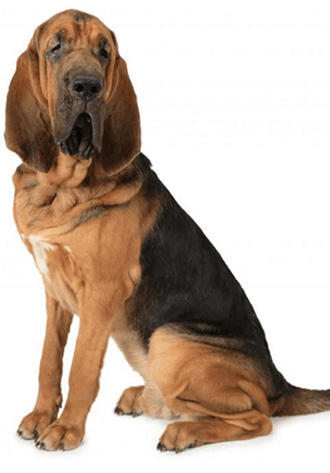
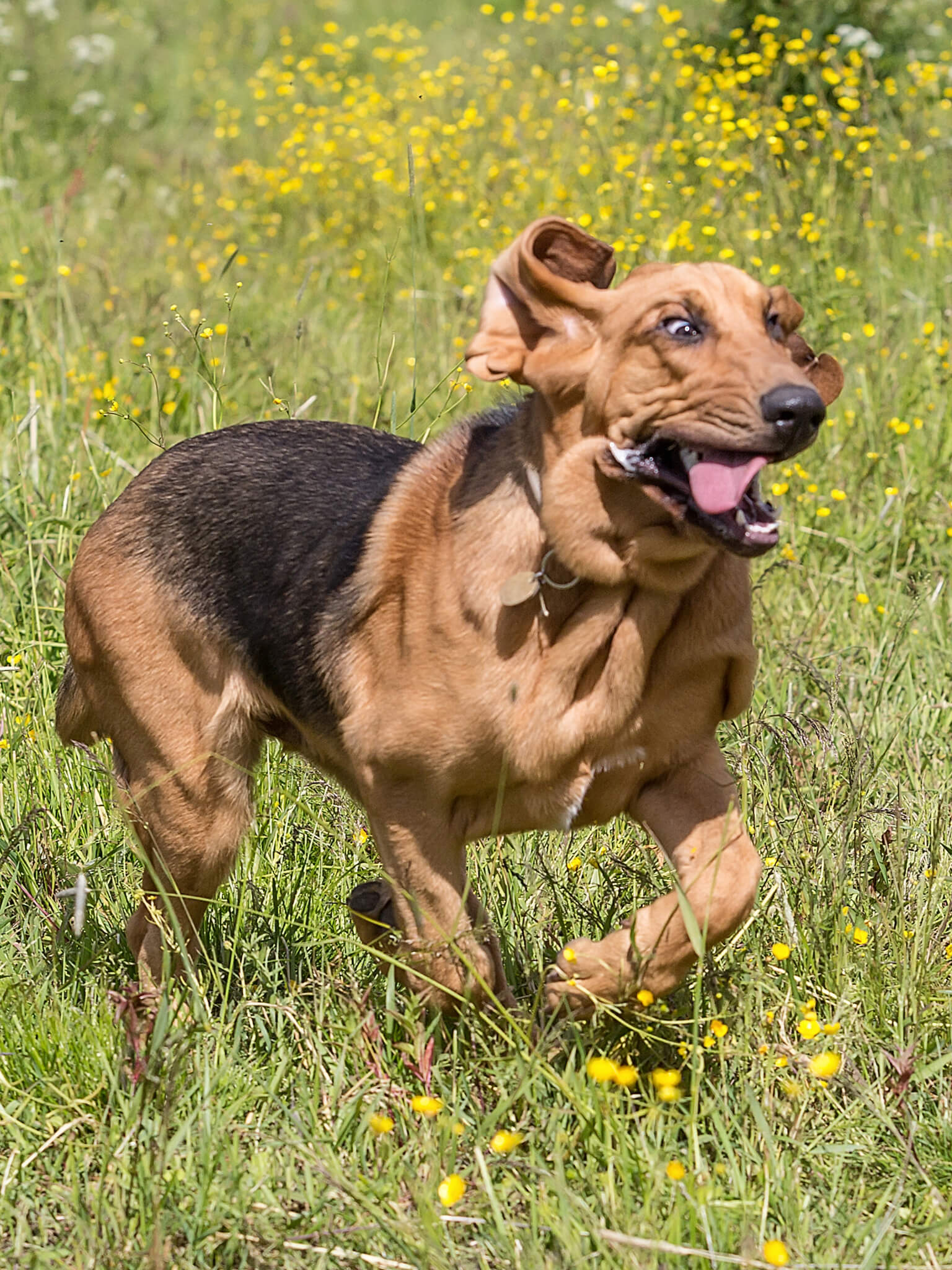
One of the most recognized of the hound group, the Bloodhound is a caricature of love and devotion. Their deep-set eyes droop in an endearing way and their loose wrinkled skin folds softly forward when their head is down. The velvety large ears are soft to the touch but also, along with the folds of skin, serve as collectors of scent information that the nose will efficiently use while tracking.
The Bloodhound is a very powerful, massive hound with a very well-muscled neck, and a back that is extraordinarily strong for the dog's size. Powerful shoulders allow the dog to work for long hours without a break. The tail is long and is carried in an elegant curve above the top of the back.
Coat Color
The colors of the Bloodhound are black and tan, liver and tan, and red and sometimes tawny. The darker colors of the breed are sometimes interspersed with lighter or badger-colored hair, and sometimes flecked with white. A small amount of white is permissible on chest, feet, and tip of stern.
Coat Type
A short, fairly hard coat of hair covers the body of the Bloodhound. The hair is softer on the skull and ears. The coat of the Bloodhound is extremely weatherproof.
Height
Males 25-27”
Females 23-25”
Weight
Males 90-110 Lbs.
Females 80-100 Lbs.

Free Bloodhound Training Secrets
Free Course on Bloodhound Training & Obedience
Stop All Bad Behavior, Excessive Barking and Biting
Bloodhound Personality Traits
Bloodhound Temperament
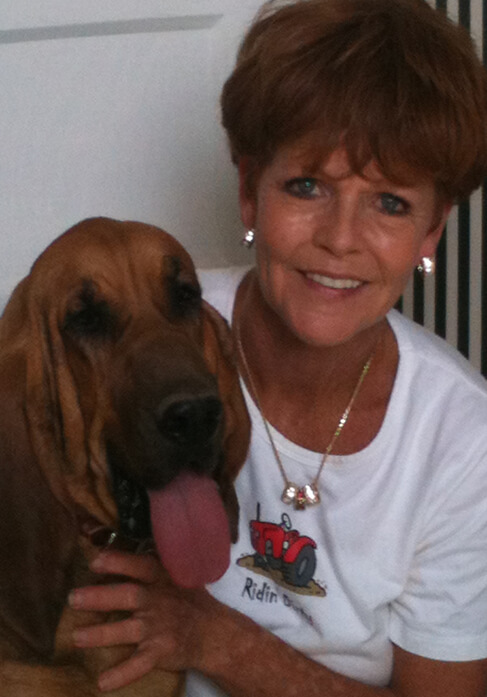
Bloodhounds are determined, responsive, gentle, affectionate, and sensitive. They are good with almost anyone they come in contact with and will be friendly with them. They are reserved with strangers initially but warm up to them soon.
The breed is extremely affectionate, neither quarrelsome with companions nor with other dogs except dogs of the same sex on rare occasion. The Bloodhound's nature is somewhat shy, and equally sensitive to kindness or correction by his master.
Early training of any kind is recommended and needs to be followed for the better enjoyment for both pet and owner. They can be stubborn on a trail and refuse to be called off if he is not ready. A trip in the woods off-lead will surely guarantee your Bloodhound a wild run and cause for YOU to find HIM wherever his nose takes him.
When the breed is inside they remain calm, quiet and affectionate.
Having the rare ability to follow a human scent, the Bloodhound uses his sharp sense of smell and determination and stamina to walk almost endlessly in pursuit. Therefore, the breed requires exercise in a fenced yard or on lead daily. Invisible fencing will not contain the drive to follow scent that this breed possesses.
Bloodhounds, in general, are delightful characters, and are lively, entertaining, and very loyal. They crave constant love and attention from you and your family members.
Better suited to an indoor or outdoor lifestyle?
Bloodhounds love to bay and therefore should be in an area that is not largely affected by loud sounds. They also need a rather large yard and room to run. Bloodhounds will not be moved by their master when on a scent, and therefore need an enclosed yard with a fence. They should also be kept on a leash when outside of a yard or house due to their disobedience. Bloodhounds do best in rural homes with a patient owner or one familiar with the breed.
Bloodhounds can never be kept in an unfenced yard. Instinct will always set them wandering off on some trail.
They can be protective of their domain, if no one is home, but out on a trail, they will welcome anyone. Some will bark and let you know when strangers are around. They can live in harmony with other dogs and household pets. Bloodhounds have a tendency to howl, snore, and drool a lot. He may also sniff inappropriately.
Are they suited to homes with kids?
The Bloodhound is great with children of any age and will be tolerant of their activities and contact almost to a fault. They welcome strangers so will not be protective or serve as a watchdog.
Bloodhound Activity Level
How Active is the Breed?
Bloodhounds love a good run and need a lot of exercise. They should be taken for a long, daily walk. They have an incredible level of stamina and can walk for hours on end. They would greatly enjoy hiking with you, but keep in mind their urge to investigate any interesting scent. Do not overtire them with walks until they are fully grown. The Bloodhound is a big dog that grows rapidly and needs all its energy for developing strong bones, joints and muscles. This is a breed that needs to take a direction of training and stay with it so the dog will not become confused.
If field trials are something you would like to participate in with your Bloodhound, then it would not be fair to expect a calm walk in the park to transpire with your pet on lead as well.
How Much Exercise Does the Dog Need at every stage of its Life?
Young puppies need to play catch, fetch and tug-of-war in addition to short walks on lead. The Bloodhound is a large-boned breed and needs lots of time for these bones to develop properly. Long walks should lengthen as the dog matures and not be rushed until his body is ready.
Grooming
The smooth, shorthaired coat is easy to groom. Groom with a hound glove and bathe only when necessary. A rub with a rough towel or chamois will leave the coat gleaming. This breed is an average shedder.
Toenails need weekly clipping. Care should be taken to keep their ears clean of debris and ticks as they are floppy and hang low to the ground, picking up all kinds of dirt while trailing.
Bloodhounds are inherently clean and tend to care for themselves well but their ears can have a distinctive doggy odor which is offensive to some people. Earnest frequent cleaning by you will go a long way in keeping this to a minimum.
Free Bloodhound Training Secrets
Free Course on Bloodhound Training & Obedience
Stop All Bad Behavior, Excessive Barking and Biting
Health and Care
Genetic Problems
Bloat is a health issue to most large dogs, but Bloodhounds can be particularly susceptible to it because of their deep chests. You should feed two or three small meals a day instead of one large one. Avoid exercising your Bloodhound immediately after meals.
The Bloodhound is prone to hip dysplasia and luxation of the patellas. Testing of the bloodline will help to keep this to a minimum. Sleeping on a padded bed will help ease any discomfort of these areas after a long hunt and avoid calluses on the joint areas.
Some Bloodhounds tend to get entropion, where the eyelids turn inward but a careful breeder will be watchful of this.
Breeding the Dog and any Cautions
Check with your breeder to determine a proper mate for your Bloodhound.
Litter Size: 8-10 Puppies
Life Span: 10-12 Years
National Breed Clubs
National Breed Clubs
British – The Bloodhound Club ok UK
Association of Bloodhound Breeders
UKC considers this a 'vulnerable native breed'
– one of British origin whose numbers are
declining
US – American Bloodhound Club
Other Recognition: CKC, FCI, AKC, UKC, KCGB, CKC, ANKC, NKC, NZKC, APRI, ACR
Rescue:
BloodHound.org
Group: AKC Hound, KCGB Hound Group.
AKC Popularity Ranking: 49
Also Known As: Flemish Hound
Train Your Bloodhound To Listen To You
Get Instant Access to Your Training Now - For Free
Sign up for our Free Bloodhound Mini Course to have a housebroken, obedient dog that happily comes to you every time you call.
You'll learn new commands to obedience-train your dog as well as how to housebreak your dog in 6 days or less.
You'll also learn how to eliminate bad habits like barking, nipping or biting, jumping, or pulling on the leash.Here's just s small fraction of what else you'll learn in the course:
How to lead and think like a pack dog - the new psychology.
3 dangerous mistakes that most Bloodhound owners make when they are trying to potty train their dogs.
The 2 main reasons why your dog barks excessively and how to control its excessive barking.
How to obedience train your Bloodhound to permanently end behavioral problems like Jumping, Aggression, Pulling on Leash.
A surprisingly easy way to teach your dog cool new tricks.
How to improve your dog's lifespan and keep it from getting overly heavy with a healthy and nutritious diet.
Getting Pro help fast - how to get access to our expert trainers when you need them most.
One hidden psychological trigger that all Bloodhounds have... that practically allows you to "analyze" and "control" your dog's every action.
Priority access to the free online seminars conducted by our training experts.
Whereas other dog training related web sites and books offer generic information for dogs in general, ours is the ONLY web site that offers Bloodhound information specifically, from a renowned panel of experts - because as you probably know, Bloodhounds have their own special training requirements that other dogs don't have.




What Other Dog Owners Say…

Our Free Courses
Dog Obedience TrainingDog Housetraining
Stop Dog Barking
Stop Dog Biting
HomeMade Dog food
Dog Grooming
Adopting A Dog
Read More
PureBred Dog BreedsMixed Dog Breeds
Dog Groups
Training Small Dog Breeds
Training Medium Dog Breeds
Training Large Dog Breeds
Exercising Your Dog
Dog Health
More Articles
Dog Grooming Needs
Our Tribute