Privacy Policy: Your email address is 100% safe.
We don't spam and hate it as much as you do :-) You can also unsubscribe from our mailing list at any time.
Subscribe to The FREE Alaskan Malamute Training Course to learn how you can easily turn your unruly and disobedient Maly into a loving, friendly companion. Step-by-step tips for puppy housebreaking, dog obedience training and stopping bad behavior.
Sign Up
Sign Up
Alaskan Malamute: Personality, Exercise, Grooming
About Alaskan Malamute
Country of Origin, History of Alaskan Malamutes
From Nordic dogs and the Arctic wolf, the Alaskan Malamute got its name from the Mahlemuts Alaskan tribe that raised and cared for them. The Mahlemuit Eskimos used them as their only form of transportation. They pulled light traveling sleds and hauled heavy loads of food and supplies.
The Malamute went with Admiral
Byrd’s expeditions to the pole. They
are known for their endurance and strength.
Many packs of Malamutes have pulled sleds
for polar expeditions because they have tenacity,
sense of direction, and an excellent sense
of smell.
Alaskan Malamutes have been used for sledding, carting, search and rescue, weight pulling and racing although they are not speed dogs.
Alaskan Malamute Tools
Breed Selector Tool - is the Alaskan Malamute the right breed for you?
Is the Alaskan Malamute the right breed for you and your family?
Find out by using our Free Dog Breed Selector Tool
Check Your Alaskan Malamute's Learning Style
Are you aware dogs also have a learning style that can greatly affect their ability to housetrain as well as be trained correctly. Evaluate your Alaskan Malamute's learning style and personality using our free Learning Style tool so that you are better able to provide him with the proper Alaskan Malamute training methods.
Is your Alaskan Malamute dominating over you?
Does your Alaskan Malamute bark unnecessarily? Does your Alaskan Malamute come to you when you call? Download a FREE Report on Dog Dominance for you and your Alaskan Malamute and learn how to control your dog.
Do you make these mistakes with your Alaskan Malamute?
Are you inadvertently snow-balling bad behavior in your Alaskan Malamute? Evaluate your Dog Training Style from our Free Tool and learn how best to deal with your dog.
Alaskan Malamute Calorie Calculator
Do you know how many calories your Alaskan Malamute needs every day and how many cups of food you should be giving it every day? Click here to use our Alaskan Malamute Calorie Calculator.
A General Appearance of the Dog
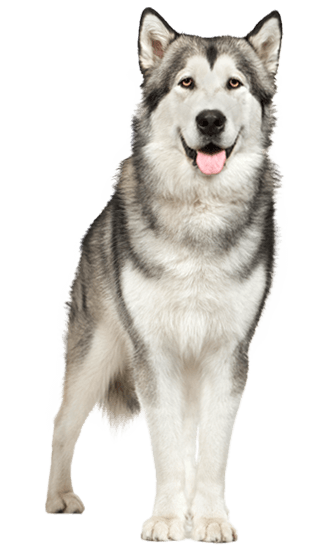
Alaskan Malamute is a heavily boned, powerful dog with a heavy medium short coat and a plumed tail that curls up over his back. His head is broad with triangular, erect ears. The Malamute has distinctive facial markings that include a cap over the head. The face can either be all white or marked with a bar or mask. He appears proud, well built, strong, and steady. His alert expression also indicates the boundless energy he possesses. The feet are furry and have very tough pads. Brown eyes give him the look of a sweet wolf. The AKC does not accept blue eyes.
Coat Color
The Malamute coat colors range from white, black and white, wolf gray, wolf sable (red undercoat with dark gray outer coat), or red – with darker highlights. The only solid color allowed is all white. White is always the predominant color on underbody, parts of legs, feet, and part of face markings. The Malamute has distinctive facial markings that include a cap over the head. The face can either be all white or marked with a bar or mask.
Coat Type
The coat is one to three inches in length. It is very dense. It is shed profusely throughout the year with twice a year full shedding of the coat. The Malamute is clean and odorless.
Height
Male: 24-26 inches
Female: 22-24 inches
Weight
Male: 80-95 lbs
Female: 70-85 lbs

Free Alaskan Malamute Training Secrets
Free Course on Alaskan Malamute Training & Obedience
Stop All Bad Behavior, Excessive Barking and Biting
Alaskan Malamute Personality Traits
Temperament of the Dog
The energetic Alaskan Malamute youngster is always ready to play. Friendly and affectionate, they are good with older children.
Adult Malamutes are quieter and more dignified; however, they remain active indoors and outdoors. Males are very dominant.
Malamutes need plenty of attention and early, firm training to keep them from becoming destructive when they need to be left alone.
The Alaskan Malamute does not need as much food as you might think; however, he will gulp everything he is given. Therefore, he is prone to bloat and obesity. Knowing this should help the owner to be careful to feed a couple of small meals a day.
Better suited to an indoor or outdoor lifestyle?
The Alaskan Malamute loves to be outdoors, especially in cool weather. In hot weather he needs to be in the air conditioning. He loves a large yard and is not suited to apartment living. Make sure the fencing is tall and the base of it is buried. If in an appropriate climate, he is happy to live outdoors as long as he gets plenty of “people time” with his human pack members. Companionship and pack time are important to them.
Outdoor games and activities that you and your Malamute can do together will make him happy.
Are they suited to homes with kids?
Malamutes can live with older children who learn to handle and play with them appropriately.
Training
Malamutes may be slow with housebreaking because they are primarily an outdoor dog. Socialization needs to start early. If you want your Malamute to get along with cats or other small animals, introduce them when he is a puppy. It is not hard to teach Malamutes to be well-mannered since they love to please.
Formal obedience training is important for this breed, but they may be difficult and need a firm hand. They can be stubborn.
Free Alaskan Malamute Training Secrets
Free Course on Alaskan Malamute Training & Obedience
Stop All Bad Behavior, Excessive Barking and Biting
Alaskan Malamute Activity Level
How Active is the Breed?
Alaskan Malamutes are a fairly active breed. They love to play. They desire a long walk each day at the very least, but cannot do much in hot weather. Make sure they have shade and cool water to drink if the weather is warm. They love cool and cold weather.
How Much Exercise Does the Dog Need at every stage of its Life?
The Alaskan Malamute is not recommended for apartment living. They love to play both indoors and outdoors.
A tall fence with the base buried and secured is necessary for the Malamute.
Grooming
The Alaskan Malamute will require twice a week brushing. He is a massively heavy shedder. Twice a year he will need a shedding blade several times.
Free Alaskan Malamute Training Secrets
Free Course on Alaskan Malamute Training & Obedience
Stop All Bad Behavior, Excessive Barking and Biting
Health and Care
Alaskan Malamute is prone to obesity and bloat. Feed a couple of small meals a day. They do not need as much food as you would expect.
Genetic Problems
They are prone to hip dysplasia, but no more than any other large breed and less than many others. Some are prone to chondrodysplasia, which is dwarfism. Some clubs require OFA, CERF, and CHD (dwarfism test) certification of both parents.
Litter Size
Litters average 6 puppies.
Life Span
Alaskan Malamutes live 12-15 years.
National Breed Clubs
National Breed Clubs
British – The Alaskan Malamute Club of the UK – www.alaskanmalamute.org.uk
US – Alaskan Malamute Club of America - www.alaskanmalamute.org
Other Recognition – classifications - FCI, AKC, UKC, KCGB, CKC, NKC, NZKC, CKC, APRI, ACR
Rescue Linkwww.malamuterescue.org
Group: Working Dog Group.
AKC Popularity Ranking: 57
Also Known As: Malamute
Train Your Alaskan Malamute To Listen To You
Get Instant Access to Your Training Now - For Free
Sign up for our Free Alaskan Malamute Mini Course to have a housebroken, obedient dog that happily comes to you every time you call.
You'll learn new commands to obedience-train your dog as well as how to housebreak your dog in 6 days or less.
You'll also learn how to eliminate bad habits like barking, nipping or biting, jumping, or pulling on the leash.Here's just s small fraction of what else you'll learn in the course:
How to lead and think like a pack dog - the new psychology.
3 dangerous mistakes that most Maly owners make when they are trying to potty train their dogs.
The 2 main reasons why your dog barks excessively and how to control its excessive barking.
How to obedience train your Alaskan Malamute to permanently end behavioral problems like Jumping, Aggression, Pulling on Leash.
A surprisingly easy way to teach your dog cool new tricks.
How to improve your dog's lifespan and keep it from getting overly heavy with a healthy and nutritious diet.
Getting Pro help fast - how to get access to our expert trainers when you need them most.
One hidden psychological trigger that all Alaskan Malamutes have... that practically allows you to "analyze" and "control" your dog's every action.
Priority access to the free online seminars conducted by our training experts.
Whereas other dog training related web sites and books offer generic information for dogs in general, ours is the ONLY web site that offers Maly information specifically, from a renowned panel of experts - because as you probably know, Malys have their own special training requirements that other dogs don't have.




What Other Dog Owners Say…

Our Free Courses
Dog Obedience TrainingDog Housetraining
Stop Dog Barking
Stop Dog Biting
HomeMade Dog food
Dog Grooming
Adopting A Dog
Read More
PureBred Dog BreedsMixed Dog Breeds
Dog Groups
Training Small Dog Breeds
Training Medium Dog Breeds
Training Large Dog Breeds
Exercising Your Dog
Dog Health
More Articles
Dog Grooming Needs
Our Tribute