Privacy Policy: Your email address is 100% safe.
We don't spam and hate it as much as you do :-) You can also unsubscribe from our mailing list at any time.
Subscribe to The FREE Boxer Training Course to learn how you can easily turn your unruly and disobedient Boxer into a loving, friendly companion. Step-by-step tips for puppy housebreaking, dog obedience training and stopping bad behavior.
Sign Up
Sign Up
Boxer: Training, Breed Personality, Fitness & Care (German Boxer)

About Boxer
Country of Origin, History of Boxers
This handsome, well-sculpted, graceful animal is a loyal family companion and one of the most exuberant breeds around. Canine clown and court jester are names that have oft been used to describe this jovial, outgoing breed that is highly valued as an affectionate pet and guardian of home and family.
Several theories exist regarding the origin of the Boxer. One theory from the 1800s, maintains that the Boxer was developed in Germany as a cross between the mastiff-type bullenbeisser and English bulldog. Due to its ability to hunt and secure game, the breed was used for hunting and was popular with working-class people.
The Boxer was bred throughout Europe during the 1890s, and the breed entered the United States shortly after the start of the early 20th century.
The origin of the Boxer’s name is somewhat questionable. Some historians state that the name is taken from the dog’s ability to fight while standing on its hind legs and making boxing motions with its front paws; whereas others suggest the name comes from its box-like head, or aggressive behaviour.
The Boxer was employed as a messenger, carrier, attack dog, and guard dog in World War I. After the war, the Boxer’s popularity increased in Europe, and it soon became favored as a companion, show, and guard dog. The dog was brought to America in the late 1930s, after which it became popular internationally.
Friendly and energetic, the Boxer is one of the favorite breeds of dogs in America and as of 2005 Boxers were the seventh most popular dog breed in the United States.
Boxer Tools
Breed Selector Tool - is the Boxer the right breed for you?
Is the Boxer the right breed for you and your family?
Find out by using our Free Dog Breed Selector Tool
Check Your Boxer's Learning Style
Are you aware dogs also have a learning style that can greatly affect their ability to housetrain as well as be trained correctly. Evaluate your Boxer's learning style and personality using our free Learning Style tool so that you are better able to provide him with the proper Boxer training methods.
Is your Boxer dominating over you?
Does your Boxer bark unnecessarily? Does your Boxer come to you when you call? Download a FREE Report on Dog Dominance for you and your Boxer and learn how to control your dog.
Do you make these mistakes with your Boxer?
Are you inadvertently snow-balling bad behavior in your Boxer? Evaluate your Dog Training Style from our Free Tool and learn how best to deal with your dog.
Boxer Calorie Calculator
Do you know how many calories your Boxer needs every day and how many cups of food you should be giving it every day? Click here to use our Boxer Calorie Calculator.
A General Appearance of the Dog
The Boxer is a medium sized, square built dog with a noble appearance. He combines strength and agility with elegance and style.
The breed has a short back, strong limbs and a short square muzzle with a protruding lower jaw and facial wrinkles. His well-developed muscles are hard and appear smooth under taut skin. The Boxer nose is broad, and the top of the muzzle appears slightly pushed in, leaving the jaw a bit undershot — the lower jaw protrudes beyond the upper jaw and curves slightly upward.
Most Boxers in the United States have docked tails and cropped ears but in some countries, these cosmetic procedures are outlawed. The dog’s dark soulful eyes combined with the wrinkling of the forehead, gives the Boxer head its unique quality of expressiveness.
Coat
The Boxer coat is smooth, shiny and tight fitting. The dog may be of fawn or brindle colour with white markings, which must not exceed one-third of the ground colour to meet the official breed standard. White, mostly white, and black dogs are disqualified from the conformation ring. The bias against too much white on the dog probably began in World War I, where many Boxers served on the front lines. White made an easy target for enemy snipers.
Height
Male: 23 to 25 inches
Female: 21 ½ to 23 ½ inches.
Weight
Male: 70 pounds
Females: 60 pounds.

Free Boxer Training Secrets
Free Course on Boxer Training & Obedience
Stop All Bad Behavior, Excessive Barking and Biting
Boxer Personality Traits
Temperament of the Boxer Dog
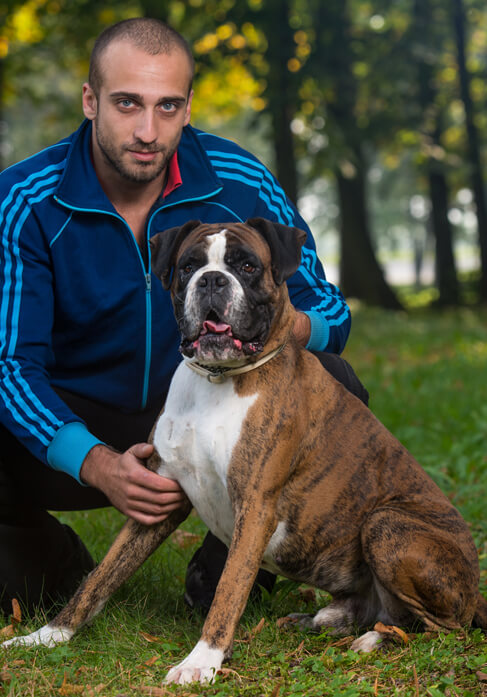
The Boxer is a friendly breed, devoted to his family. His temperament is fundamentally playful, yet he is patient and stoical with children. He is tolerant of their antics and loves to play. He is a natural protector and, if trained, can be a good watch and guard dog.
Without training, some Boxers tend to be too friendly and would rather lick and play with an intruder instead of guarding. Above all, a Boxer should be even-tempered, dignified but with a touch of impish spirit, and full of courage.
Aggression, extreme shyness (not to be confused with independence), and hyperactivity are unacceptable in the breed; those who are considering a Boxer should check the parent dogs for these undesirable traits before even looking at the puppies.
The Boxer is the ultimate people dog. He is deliberate and wary with strangers but curious, and he will exhibit fearless courage if threatened. Boxers can adapt to nearly any environment, as long as they are with people.
Better suited to an indoor or outdoor lifestyle?
The adult Boxer is better suited to an outdoor lifestyle due to its athletic prowess and inclination to move around. Also, the Boxer has been bred to be courageous; it is used as a guard dog and in military or law-enforcement capacities. These occupations frequently use the dog in open environments, and it becomes strong, agile, and used to regular exercise. As a result, it is most comfortable when access to the outdoors is available. If an owner prefers that the animal stay in the home, a 'dog door' that provides access to the outside is recommended.
Are they suited to homes with kids?
The dog's patient and playful nature make him an ideal companion for young children. Though they are excellent family pets, they tend to fight among themselves, especially if the other family Boxers are the same sex.
Training
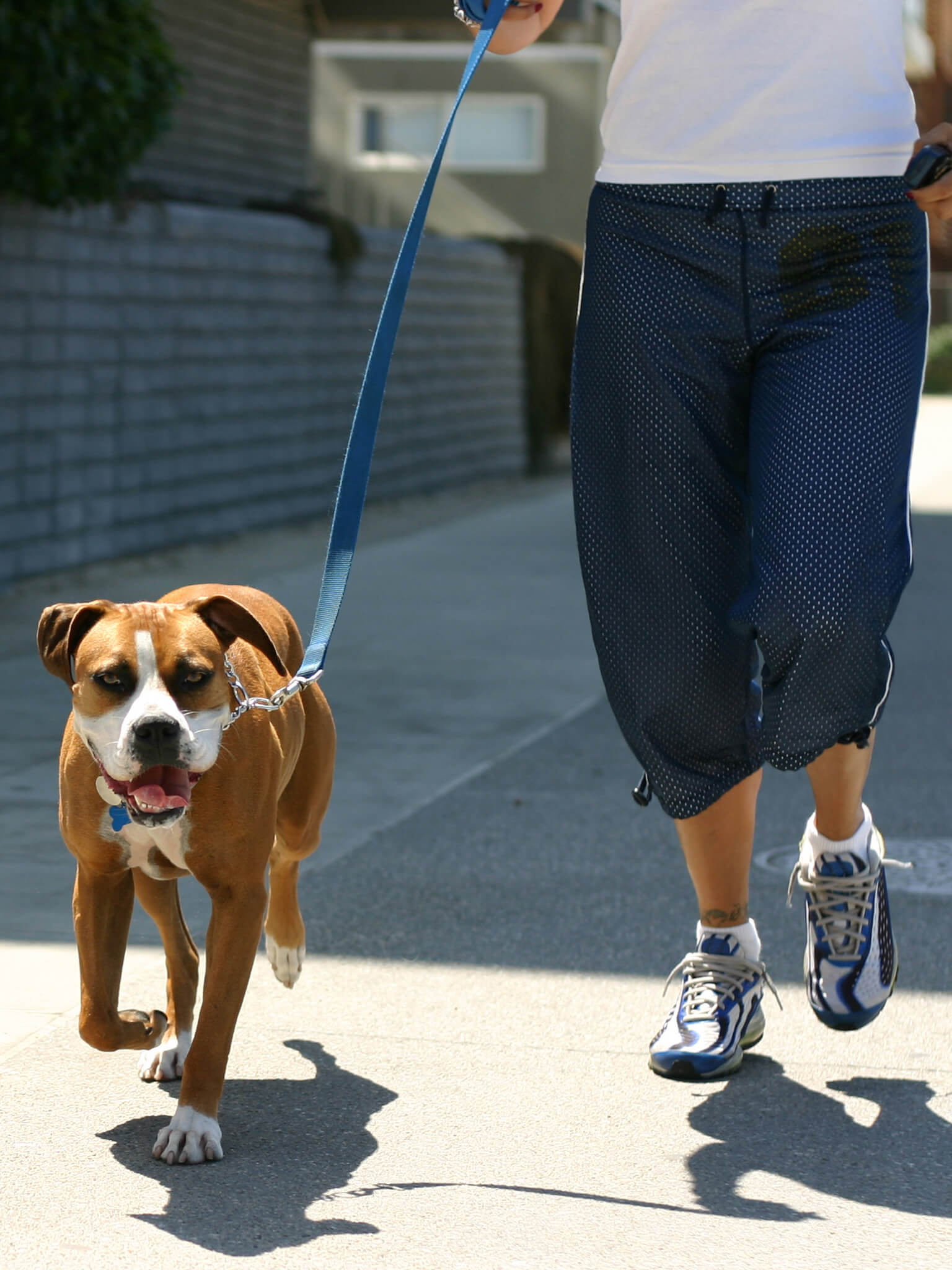
Although the Boxer is a loyal and intelligent family companion, his somewhat stubborn and self-confident character, and high prey drive requires careful consideration. He must be obedience-trained to control his exuberance and guide his mettle into acceptable channels. He is, after all, a big, strong dog.
The breed’s exuberance can also be exasperating at times. Boxers are inclined to greet those they love - and some people whom they would like to love - by hurling themselves at those persons' chests. The pup must be taught to greet people correctly at a young age and the training must be reinforced occasionally throughout adulthood.
Free Boxer Training Secrets
Free Course on Boxer Training & Obedience
Stop All Bad Behavior, Excessive Barking and Biting
Boxer Activity Level
Exercise Needs
Boxers and their owners are happiest when the dogs are properly exercised. Boxers have been bred to be active, athletic, and are capable of hard work. These dogs need daily exercise, such as thirty-minute walks, playing 'catch', or running outdoors, and mental stimulation by interacting with a playmate or trainer.
Boxer pups, especially, are known to be very active and energetic, and though the activity levels diminish with age the Boxer requires physical and mental stimulation throughout its life.
The Boxer is not ideally suited for an indoor environment, which consists of long periods of inactivity. If the dog is left alone without exercise, it might chew and destroy shoes, furniture, or items left lying around the house.
How to take care of a Boxer Puppy?
How to take care of the Boxer Puppies?
When the Boxer is still a puppy, it requires consistent human companionship. The pup can be very playful and high-spirited to the extent that it welcomes strangers into the home. As with any breed, the Boxer pup needs to be housebroken and trained not to jump on people or furniture.
The dog has an exceptional amount of energy and can easily learn various tasks. However, the Boxer puppy can also be resistant or even devious in its behavior. The pup will quickly bond with an owner and other family members, especially children.
As with any breed of dog, there are countless breeders of the Boxer, from reputable professionals to unscrupulous ‘mills’ that reproduce animals solely to make money. A reputable breeder will produce the Boxer’s registration papers and/or pictures of the dog’s lineage. Although the papers do not guarantee superior health or temperament, a reputable breeder will have raised the dog in a caring home or kennel. As a result, the dog will display fewer health and behaviour problems.
A potential owner is well advised to perform research on Boxer breeders and select one with high standards and a reputation that is beyond reproach. This information can be accessed via the Internet, through community agencies, and in reference books on the Boxer.
Grooming
The dog’s short, hard coat does shed and needs some grooming with a soft brush. His coat\'s natural sheen can be enhanced with occasional rubdowns with a chamois cloth.
Unless a Boxer lies down or rolls about in some noxious substance - or becomes a hostel for fleas - he will seldom need a bath. A Boxer\'s ears should be cleaned with a cotton swab or ball that has been dipped in mineral oil. Cleaning should extend no farther than the eye can see; poking around in the ear canal could cause damage.
Free Boxer Training Secrets
Free Course on Boxer Training & Obedience
Stop All Bad Behavior, Excessive Barking and Biting
National Breed Clubs
National Breed Club
In the United Kingdom, The Boxer Club of New South Wales promotes the Boxer. http://www.nswBoxer.com/.
In the United States, The American
Boxer Club represents this breed.
http://americanBoxerclub.org/.
Recognition
Both the American Kennel Club and The Kennel Club in the United Kingdom recognize the Boxer as a “Working dog”.
Based on 2005 American Kennel Club statistics, Boxers are the seventh most popular breed of dog in the United States with approximately 37,268 new registrations during the year.
Group: Working Group
AKC Popularity Ranking: 11
Also Known As: German Boxer, Deutscher Boxer
Train Your Boxer To Listen To You
Get Instant Access to Your Training Now - For Free
Sign up for our Free Boxer Mini Course to have a housebroken, obedient dog that happily comes to you every time you call.
You'll learn new commands to obedience-train your dog as well as how to housebreak your dog in 6 days or less.
You'll also learn how to eliminate bad habits like barking, nipping or biting, jumping, or pulling on the leash.Here's just s small fraction of what else you'll learn in the course:
How to lead and think like a pack dog - the new psychology.
3 dangerous mistakes that most Boxer owners make when they are trying to potty train their dogs.
The 2 main reasons why your dog barks excessively and how to control its excessive barking.
How to obedience train your Boxer to permanently end behavioral problems like Jumping, Aggression, Pulling on Leash.
A surprisingly easy way to teach your dog cool new tricks.
How to improve your dog's lifespan and keep it from getting overly heavy with a healthy and nutritious diet.
Getting Pro help fast - how to get access to our expert trainers when you need them most.
One hidden psychological trigger that all Boxers have... that practically allows you to "analyze" and "control" your dog's every action.
Priority access to the free online seminars conducted by our training experts.
Whereas other dog training related web sites and books offer generic information for dogs in general, ours is the ONLY web site that offers Boxer information specifically, from a renowned panel of experts - because as you probably know, Boxers have their own special training requirements that other dogs don't have.




What Other Dog Owners Say…

Our Free Courses
Dog Obedience TrainingDog Housetraining
Stop Dog Barking
Stop Dog Biting
HomeMade Dog food
Dog Grooming
Adopting A Dog
Read More
PureBred Dog BreedsMixed Dog Breeds
Dog Groups
Training Small Dog Breeds
Training Medium Dog Breeds
Training Large Dog Breeds
Exercising Your Dog
Dog Health
More Articles
Dog Grooming Needs
Our Tribute